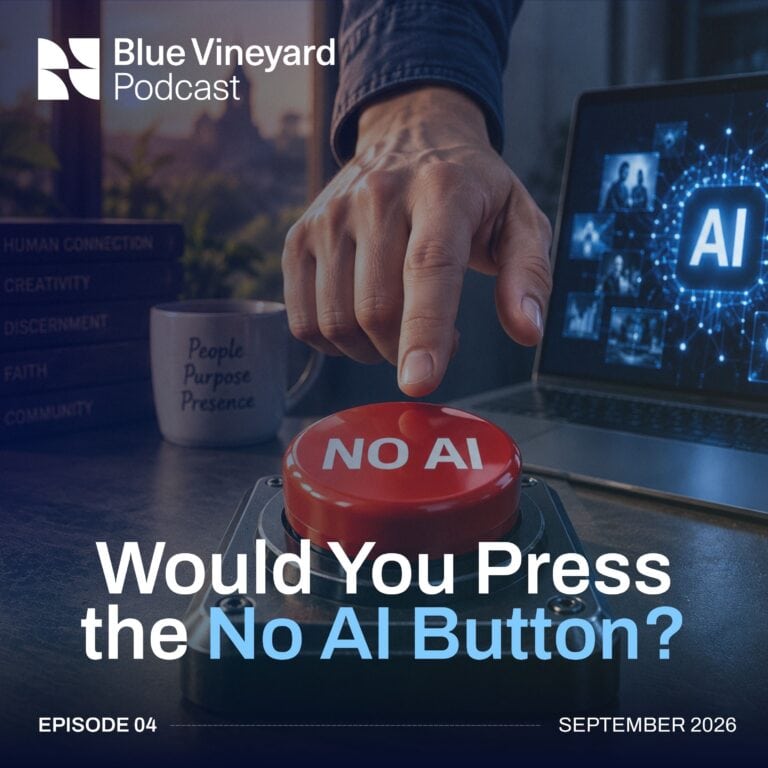
If you could press one button and make AI disappear, would you?
The guys found it to be one of the hardest q’s to answer. Luke started wanting to press it, Adam refuses. Listen to the end to hear where they landed.
FEATURED VOICES
🔗 Brent Hardinge, Director of Adventist Connect, North American Division: https://adventistconnect.org
🔗 Pastor Russ Willcocks: https://www.linkedin.com/in/russ-willcocks-13126640
🔗 Pastor Puia Fanai, Hope Channel: https://www.linkedin.com/in/puia-fanai-21945b196/ | https://www.facebook.com/rspuiafanai/
🔗 Pastor Jëan Ross, Amazing Facts
CONNECT WITH BLUE VINEYARD
🔵 Subscribe for more insights on faith and technology
🎙️ Audio Podcast: https://rss.com/podcasts/bluevineyard/
🌐 Website: https://bluevineyard.com
💼 LinkedIn: https://www.linkedin.com/company/blue-vineyard/
✉️ Get in touch: [email protected]
Episode transcript 5,506 words
If creating AI makes an on-ramp for 100 million people to be exposed to the gospel that would never before, how much bad has to happen before that's not worth it? Right, that's a really strong argument. Did you just make your argument? Did you change your mind?
You know, how much bad does it have to happen? I don't know. I don't know. I don't know.
I've at least progressed from the no button to the wait button to the yellow button, right? The slow down button. The yellow button. But are we waiting on ministering to those people, Luke?
Are we putting that off until later? We've got to finish the work. Hey everybody, welcome back to another episode of the Blue Vineyard Podcast. My name is Luke Farooja and I am here with my co-host Adam Weeks.
Adam, how are things? Oh, it's a fantastic day. The birds are singing, the flowers are blooming. I am blessed.
It sounds like a good day. It really does. It's a good day. Yeah, life's good.
How are you doing? What do you want to talk about today? I am doing really well. So I'm actually really excited because we've been working our way through this series and like bringing, bringing back all of our, um, our findings from the conversations we've been having around AI.
And in this particular episode, I think this is, this is one of the ones that is the simplest question we asked really speaking is the simplest question that we asked, but it has the, I think it demonstrates great depth in the complexity of the problem. How do you feel about that? Yeah, so I'm excited to get to today's question about, I've got this visual, I've got this picture of a bright red button. If someone could press this bright red shiny button and just. turn off AI, just AI just gone.
Would they do that? And it's an interesting question. But I think before they before we get too much into this topic today, I want to remind people that we have been on this topic for a while of how AI is is changing how we do ministry and all these are in Christianity. And so I would encourage you, if this is the first episode that you have found in the series, hit pause, go back to one of our previous episodes.
That will get you some more context for things like how Christianity is being affected by AI and essentially, does it change how we do ministry? But yeah, I'd encourage you to go back and check out those episodes that we did prior to this one. So just before we get into the the subject matter for the episode, Adam, I'm curious, what is your hypothesis? Because we're obviously we're going to go and we're going to hear some other people's thoughts.
But we want to start with what is the hypothesis that we are bringing to this that we're testing out? Well, and to give this context, give more context to this question, how I think about this question is that There is currently in many places kind of a backlash to AI. And a lot of times when we see things get really popular, it's almost it kind of swings the other way towards how we feel about a thing. And I think that has to do somewhat with the good old days.
I remember when life was simpler and like, yeah, life. did have other simplicities and and even the the question of like well uh Jesus he didn't uh have AI and look how well that went for you know like his ministry was great for him yeah yeah I do we need AI to be better Christians? Do we need, or is it actually just gonna be a distraction? Is it gonna get in the way? And there are serious concerns.
People are afraid of this, and I can't say that they shouldn't be afraid. And so yeah, here's the question. If you've got this big red button, you know what? We're better off AI.
It just isn't, is it what we would need? Would you press that red button? I don't think I'm gonna press it. I don't know.
How about you, Luke? Are you pressing that big red button? So I have two problems in order for me to answer this question. Number one is that if AI could be developed responsibly, like, no, no, no, let me rephrase that.
If AI, if we could trust humanity to develop AI responsibly, I would absolutely not press that button. But we have, you know, there's this expression. It's called it's a collective action problem. We could solve the problem if collective action took place.
If everyone was on the same page as to what was needed, we could solve the problem. My feeling is that I don't believe that humanity is is in a place to be able to solve a collective action problem as big as AI. There is always going to be one nation saying, we're going to slow down. And the other nation is going to say, that's fine.
That just gives us an advantage. And so then the first nation says, oh, well, then we just need to hurry up and throw caution to the wind. And so because of the nature of that and the complexity of the human condition, I'm afraid I would surrender my Claude subscription and I would press the red button. You're pressing the button.
All right. I mean, I'll push back a little bit, is that there was, I was watching a video recently about, when's the last time you heard about the hole in the ozone layer? And that was a threat. When I was Yeah, we saw we have the same we have the same algorithm algorithm.
And that was an example of of the world coming together to solve that problem. And currently, yeah, the the whole ozone layer is no longer the problem. But like you mentioned, she does talk about large, big things, you know, coming our way with, you know, global warming and all that, can the world come together for that singular purpose? They did it once, will they do it again?
And I think you bring up a good point with the big red button for AI. And I'm a natural optimist and I'm gonna say that on the other end of this. uh good things and bad things will happen but similar to the internet i think the positives of the internet outweigh the negatives of the internet and i'm going in that direction same with like electricity and those things good and bad but the good outweighs the bad well i'm i'm gonna say that um Despite pressing the button, I'm actually a massive fan of AI, so I am really hoping that you are right. But I think this is a good point for us to jump in though, because... I think the first place that we went, one of the discussions that I had, is that I was talking to Brent.
Now, Brent is in a technology facing role at the NAD, and I think he sees the value of it, but also the shaping that is necessary. So let's start with our video from Brent. Would you press it and why? I'm glad I don't have that kind of power.
I really don't think I would. I think there is some amazing things that are being done with AI. It's a technology that I use probably every day in different ways, within the work that I do, within the study that I do, recognizing obviously that it is AI, that I still need to think for myself. I think it can be a force multiplier. in what we do, whether it comes to software development or whether it comes to even processing vast amounts of data.
But I'm not sure I'm at the point where I would say, yeah, we need to delete it all. I think there's a lot of value that can come from these kinds of technologies, but we need to choose where we put them into play and how we use the technology. Delete it? No.
I think I think there's still a lot of value in AI, but we just get to choose where we where we put that. So I think he's he's dealing with it at the grassroots level, right? Like where where do we put AI into practice? And so like what what are your thoughts on that, Adam?
Where do you think is the is the right place? Where do you want AI to be? I I think. My closest connection to this or how I think about it is going to be similar to like the industrial revolution.
If you know, over 100 years ago, you and I probably would have been farmers, we would have needed to spend most of our time producing food for our family. The vast majority of people in you know, we're we're working towards just we got to eat. My last name means farmer by the way, so yeah, so you definitely absolutely I didn't I learned something new join the blue veneer podcast where you learn something new about Luke And My again optimistic side is that I do a lot of stuff that I don't Enjoy doing and a lot of other people do as well. They don't enjoy their work and My hope is that the only way we get to what's next is this opportunity with AI to take out the drudgery work, the stuff that people don't need to be doing anyways, but we've built such a complex world that it has to be done where we're filing reports and doing all this stuff like, yeah, no one needs to do that.
Go paint, go run, go do something with your hands. And a lot of this knowledge work that's really just busy work can hopefully be offloaded to the AI and we can get to the creative fun stuff. Yeah, I think that's a great way of putting it. Another way of framing it the way I've thought about it is that if I think about generative AI in particular, I don't know how you feel about this, Adam, but when I'm scrolling through my algorithm, my feed on any app, If I see a video or a photo and I can tell there's just those little tells that I know it came from, from an AI source.
Do you have a higher or a lower opinion of the piece? 100% lower. Um, 100% it's yeah. So with that point, it's that somebody because I feel like they're trying to pass off their creativity as them. It is inauthentic.
Yes. There are other times when AI is used in a way that we're all aware that it did a work and we're happy that that work got done. But then you need to add the human layer. I did a thing today where I showed someone, hey, this is It had some back and forth.
It was some work that was done with a good friend of mine. I shared it with him. I said, hey, Claude helped me create this document. It's not done yet, but I want to just evaluate the idea that Claude and I came up with together.
Do you like this idea? And then we went back and forth on it. He liked it generally, had some feedback. Now my job is to go back and turn it into what a human output would do.
Yes. And this is kind of the point that I was hoping to press on. And that is when I see something that is AI that is done in a certain way, it feels less valuable to me. And the reason is the last thing that you said is exactly the reason.
The human element is what is valuable. And so even what AI can produce, what it's producing is replicating what many humans have done. And it's like... deriving the average of what many humans have done, right? So all of the value even that AI is producing is human derived.
But what I hope AI does is exactly what you just said. It speeds up those busy work sections and it does it in a way that we can optimize for the human. It should be in service of humanity, not as a replacement of humanity. And so it has to be that point of leverage.
It needs to be the Archimedes lever, not the guy on the end of the lever. So I think that's what we need to be moving towards. I agree. I do want to step back a little bit because I think Brent gave, as I said, he was operating from his viewpoint at the grassroots level.
What do we use AI to do? When I was talking to one of the others that I was reaching out to, Pastor Russ Wilcox, I personally appreciated Russ's perspective because he was looking at it more from the top down. How do we get the governance piece right? How do we deal with the humans in the loop, which is what I was sharing in my personal hypothesis?
I really appreciated his thinking on that. I also want to share this clip from Russ as well. I think AI has enormous capacity as a tool to do great things. It can change people's lives in amazing ways.
So it has a real benefit that comes with it. And I'm thinking of things like, let's say you're part of a people group who has a language group that has limited resources. Well, AI can certainly translate video and it can translate in ways that we couldn't. in the healthcare sector. It's opening up new diagnostic tools and all that.
So these are some examples of great ways that AI is bringing huge value to these sponges. On the flip side, AI carries probably equally and probably greater challenges. Where does it bleed, Luke? That's the big question.
No one really knows the answer to, but I think with AI, At every level, here comes my answer. At every level, AI needs solid governance. Without the solid governance, how do we keep this tool from becoming a tool that ends up in the wrong hands or a tool that develops its own mind and starts to do the wrong things? So those guidelines, that governance structure at the mom and dad level all the way through to government and military levels, I think that's vitally important so that this tool may remains a force for good.
The challenge is humanity would need to work together to govern AI where it is now. It's in the hands of governments, it's in the hands of militaries, it's in the hands of companies, it's out there. And to govern it for humanity would take an effort that I think requires a lot of unity, a lot of humility, and we would have to put that race... that race, we would have to look at that race differently and collectively. And I just don't know that humanity has the track record or the will to do those things.
So my answer to that is twofold. I think, yes, we can't push the delete button. We have to learn to use these tools effectively while we can and benefit from and seek. governance at every level so that these tools are maintained in a positive way. Would I push the delete button?
I probably would, Luke. I probably would. I think the world prior to AI was a good place. It was a stable place.
I think people's jobs were not as uncertain as they are now. I think the risks and the fears that we're starting to So without creating scaremongering, I personally probably delete it. And I realized we would have to live without a lot of the huge benefits that AI brings. And I'm not anti-AI, but I'm anti-AI without governance.
And I don't know that humanity will be able to govern collectively. I think AI has enormous I just think that that's a really interesting take. And the thing that he said near the end there of, is the world a safer or a more dangerous place since AI has been invented? And I'm curious, do you think that at its base level, do you think that is a true statement that the world is a less safe place?
I think it depends on how you define safety. You know, people are worried about their jobs being taken from AI. But honestly, it's not AI that's taking their job. AI didn't walk into the room and saying, you're gone.
It is the capitalistic society, you know, all the things around there that somebody thought, hey, we can do this cheaper with AI. We don't need you anymore. And so it is, in and of itself, is that tool. And like he says, it's the governance that is so important.
The thing I I want to add here is that I feel like we we we miss yesteryear. We like of our childhood. It was a simpler time but polio was also really bad. Um we had you know like.
Yes. There's like I'm really glad that I don't spend 10 hours a day out in the field and I was this last weekend we were out apple picking and there was this um like this at his farm and they kind of had a museum of like old farm implements. And you're walking past these like old tractors that are small, but were well used in farm implements that are no longer used in modern day farming. And there's a museum there that pays tribute to those things because we've valued like at one point that tractor, that plow was everything to that farmer.
And and now it's it's rusting and oh wow isn't that cool but we walk right by it my kids don't really care and we gotta go get dessert um because there's you know apple pie to eat uh but i think there are similar things to that is that there is a grieving process to hey the things i've held on to in the past those were really valuable to me and that information but It changes and nothing stays the same. And this is I think the problem with AI is it's it's changing so much quicker. But I think back to your governance. That's important.
Yes. Yeah, absolutely. I would say that I think the there is I think it's a stretch to say that the world is a less safe place. I think there are potential futures where that could be true.
I don't think we're there now. But you know, there are I think there is potential for that to occur. Yeah. As you were pointing out, his point on governance, impossible to argue with because that really is going to be the foundation of what happens and whether it is weaponized to whatever degree.
And literally weapons like you know, what do we do with like nuclear weapons like nuclear technology has the potential to be amazing for us I remember there was like cartoons like back in the 50s and they anticipated like every toaster was gonna be like an atomic toaster and that's how we were kind of toast our bread and our cars were gonna hover through like atomic energy and like hey, you know what? atomic waste is pretty rough and Through that, there has been some progress in atomic energy and that, but there's also been regulation that has slowed it down both positive and negatively. Yeah, absolutely. So what about your conversations? Anything stood out to you from the ones that you've engaged with?
Oh, yeah, I was absolutely blessed to talk with some good friends of mine. I think one of the answers like, you know, I'm sounding very confident in my, I'm not pressing this button. But at the end of the day, like, I don't know, maybe. And I resonate with our next guest, Pastor Puya.
He had some good insight that I think was valuable. Let's go ahead and listen to Pastor Puya. If you could go and you had this big red button and push the no AI button, just push the no AI button, would you and why? That is a really good question.
I don't know. I think that's an honest answer. I don't know. Because on one hand, I see the danger of AI.
You know, there is a lot of downside. There are a lot of dangers of AI. On the other side, I also see the potential like a good use of AI. And so if I could press a button to say no AI ever, I don't know.
I think it's very hard for me. I would say I would maybe if you ask me which way do I lean more? It's like I can't answer that as a black and white, yes or no, but I would say maybe I would lean a little bit more towards no AI, but I wouldn't completely rule that out and say no, we don't need AI at all. There are a lot of positive use to this.
Maybe there's a yellow button. It's like, you know, less AI or slower AI or something like, yes. I think that would be me slower. We'll look for another button.
Thank you. Luke, have you found a yellow AI button around here anywhere? Uh, no, I haven't found the red one either. So, you know, maybe that's okay.
Would you, would you, so you came in pretty hard with, uh, Uh, yeah. Pushing that button. Would you rather if, if we were to, and this isn't how we're setting it up, would you push the yellow button instead? I would for sure.
So I was having a conversation just the other day with, uh, with Cameron, who, you know, is leads the technical work for our company. And I was saying to him, you know, genuinely I'm happy with Opus level, like, you know, in, if you're in the Claude ecosystem, I'm happy with Opus level AI. I don't need fable. I don't, I don't need mythos.
I don't like. If I just had that and that was a stable product, I'd be happy to leave it at that. But, you know, there's the constant race that's there. But I do want to, you know, what he's acknowledging there is, you know, I think very fair minded that we don't know.
And as much as there are some people that are saying, we need to stop AI. And there are some people that are saying AI is the future and it's going to be one of the greatest things that humanity has ever created. Um, the truth is that really both are true. And so pressing that button is a complicated question.
And I, this is one of the reasons that I've loved this particular question in the series because, uh, it has highlight just how complicated that answer can be. Cause I think one of the things that you were, you were mentioning before about, you know, how good yesteryear was and how people look back at, Oh, the good old days. When I think about the internet, You know, if, if we were to, you know, when the internet was just taking hold, you know, there's so much, so much bad things that came with the internet, right? You know, as you could point it, you know, human trafficking, you could point it at exploitation, you could point at pornography and all of these things that the internet enabled.
If you looked at that in isolation and you said, do we want to delete the entire internet? You know, and someone asked you that question in 1996. That would probably have yielded very different results to now when we see it as a mature and stable technology that we understand how it works. We see that the positives and the negatives and we consider it a tool that people can use for good or evil.
If we get to 2040 and we look back at AI as a mature and stable technology that is a tool in the same way, then this question becomes a little bit obsolete. So I think it's good for us to hear that perspective of what did people look at technology revolutions like in the past and how do we navigate that? Yeah, slow it down. I thought about that like, hey, could we just pause it where it's at?
Like we have AI, but just don't go any further. Again, me as the optimist, I think that we're not in a good place of AI yet. And some of the models I think that are in education, for example. And maybe it's that the technology is good enough, it's just how it's being implemented.
I don't think that a lot of sectors have seen the benefit that AI will bring. In the US, there are some school districts that are saying, hold on, for elementary and junior high, we're not gonna allow AI use for this school year. And they're not saying, we're not ever going to do it, but it's like, it's so... untested. They're so yeah, let's slow it down.
And let's put some guardrails around it. And that's I think, to me, we don't have the correct guardrails built within the systems yet. And I'm hoping that some of those things come next in that because I've got talked about education and is AI like how are we going to solve the problem of AI making it so kids can cheat easier. And I honestly think that it's more AI because it's the AI that is going to require the kids to not be able to cheat.
So it's either push the button all together or we need to hurry up and progress AI to a place where it is more useful and has better more mature and has better guardrails. to it. So yeah, I don't know that I'm pressing the maybe the slowdown button. But I want those those guardrails. That's for it's too Wild West right now.
Yeah, agreed. Agreed. And all technology started there, right? All technologies.
The I think the difference here is that we have done an excellent job, I generally speaking of building infrastructure ahead of time, when the internet came. The infrastructure didn't exist the infrastructure had to be built in real time and whilst it is true We need to be building chips and servers and and yeah the the memory You know the memory crisis where you know memory costs are going up exponentially because of AI and all of those things are true But largely the technology is there. We just need to build it. Whereas I think for previous revolutions in technology the infrastructure was not there and it had to be built in parallel with the technology.
And so I think that is a part of why this change is so rapid compared to previous waves. Yeah, I think of it comparing it to the development of the internet I think we're in the the modem stage on the 14 for the 2020 28 28 like That wasn't a great experience. We did it because we had to but eventually like my kids don't know what that sound is and I would be glad to never hear it again because it was a terrible sound and my internet was really slow and Things took forever and stop working you And my phone stopped working. Yeah, you couldn't call.
What a mess. We're showing our age. We're showing our age. Oh, man.
It is curious to see how AI is going to develop in ministry. And we have had the incredible pleasure of working with amazing facts on an absolutely just... I am so excited about this project, Ezra, that we're working on with Amazing Facts. And so I've got a chance to talk to Pastor Jean, and you can imagine someone who works at Amazing Facts who is technology forward, he's not pressing that button, but he does have some good insight as to why.
Let's listen to him now. Well, you know, I don't think I would push the no button because if we do and we don't utilize this resource, we're going to be left behind. There's going to be a lot of people out there in the world that will have an opportunity to hear the gospel using AI and using it to effectively communicate the gospel that we would miss out on if we didn't utilize it, just like the printing press. If we said no, We want to have all of our materials written by hand and that's the way we're going to distribute the gospel.
Well, you reach some people but think how many more people have been reached because of the printing press and taking Bible truth and presenting it in a way that people can hear or through the radio or through the television and goes on and on. So I don't think we need to reject this tool that's been made available. We need to think of ways that we can utilize it effectively to reach people with the gospel. Yeah, I think he makes a good point.
What do you think about what Pastor John is sharing there? I like the fact that Pastor John, he came at it directly from a missional perspective, which I would expect from Amazing Facts. The thing that he said that I really liked is that he was saying that if we were to press the button, We miss out on the the opportunity to serve people and to reach with the gospel that we would never been able to reach otherwise and i think that's a that's a true statement regardless of the of the risks i think if you weigh the the risks and you wait against the fact that i if creating. I make an on ramp for a hundred million people to be exposed to the gospel that would never before how how much bad has to happen before that's not worth it.
Right? That's a really strong argument. Yeah. Yeah.
So I feel like you did you just make your argument? Did you change your mind? You know, how much bad does it have to happen? I don't know.
I don't know. I don't know. I've at least progressed from the no button to the to the white button to the yellow button, right? The yellow button.
But are we waiting on ministering to those people, Luke? Are we putting that off until later? Got to finish the work. Oh man, it is a, this is an ongoing question and it's one that I think constantly needs to be revisited because my answer today is I'm not pushing the button, but maybe if we lack governance in the future.
I could see myself changing my mind. There are plenty of sci-fi movies out there that tell of a pretty dystopian world. And if that's where we're headed, no, thank you. I'll get pushing behind that plow and we'll go farm together, since you have all the experience.
I think your family does. Yeah, well, at least if you rewind some generations. Well, we essentially would be going back in time in many ways. I think my encouragement is to everyone is please, if you are listening to this in some place where you can give us your thoughts, would you push the red no AI button?
We'd love to hear from you. Having your perspective really means a lot to us. Yeah, I would really welcome that and appreciate that. And who knows, we may use that perspective on a future episode.
So please keep us in the loop with what you're thinking as well, and also how you are using AI in your context. Yeah, absolutely. If you've enjoyed this podcast, if you've made it this far, please consider subscribing and even better, share this podcast with someone. This is a way that you can share the work that Blue Vineyard is doing with the people that you care about that may have been wrestling with this question.
Could they benefit from this conversation and maybe... continue those conversations. So subscribe, please share this, and yeah, continue to follow us along. We've got more good questions on this topic of Christianity in the Age of AI, and we hope that you'll join us.
Transcript is automatically generated and may contain errors.