How I used AI research in Miro to benchmark our peers and rewrite the Blue Vineyard Podcast description.
I inherited the production process of the Blue Vineyard podcast about two years ago and have been producing it with Adam and Luke since then. Recently, I decided to update our podcast description. This is what it was:
The Blue Vineyard Podcast is designed to help you navigate the growing digital ecosystem. We will have expert guests and share our own experience as we build and invest in platforms to help the church in the digital space.
I had a feeling that it was missing something, and I wanted to know what. To find out, I looked at how our peers communicate value to their audiences.
How I researched 17 podcasts with AI
I started with a prompt. I asked Miro’s AI to build a process to research podcasts in our space and compare their descriptions with ours. Miro then did all of the research, working through 17 shows.
The steps are in the image below:
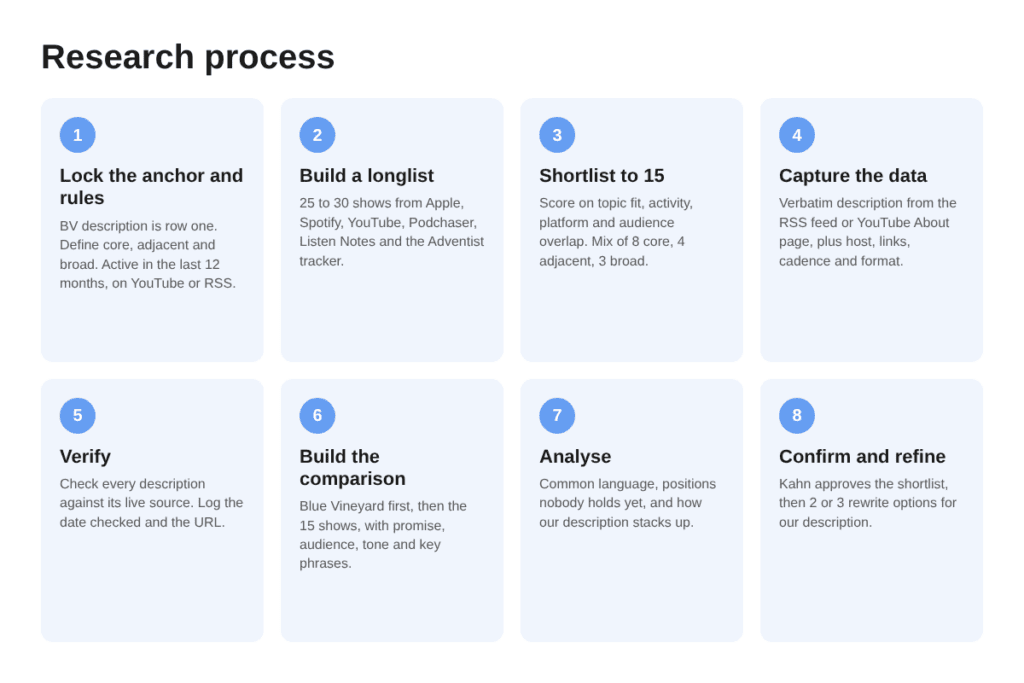
I didn’t pick the shows myself. Instead, I gave Miro the rules. Each show had to be active in the last 12 months and was scored on topic fit, activity, platform and audience overlap. The shortlist had to mix shows in our space, technology shows and a few big creator podcasts. It came back with a shortlist, and I removed a few that didn’t fit before approving it.
Miro kept all of it visible. Each step sat in order on the board, so I could always see where we were. Every show went into a table with its description, and a link to the source. Once the table was full, Miro made some suggestions and put them into sticky notes: language every show used, gaps nobody had claimed, and ideas for our rewrite.
After the process was completed, I reviewed the data and found that the shows shared some common elements, and some of them were missing from our description. For example, ours never said who the show was for, who was hosting or when new episodes arrived, and it ended without inviting the listener to do anything.
Many of the descriptions opened with a line that said what the show was about and made a core promise to the listener. They named who the show was for, introduced the hosts and why they were worth listening to, and told you what kind of guests and topics to expect. Several also shared the hosts’ own experience as builders, said how often new episodes are getting published and where to find them, and finished with some proof, a closing tagline and a call to action.
I also compared our description with three of the shows that overlapped most with ours. They shared many of these building blocks, but not every show had every one, and the language each used was very different. That told me there’s no single formula for a podcast description. Every show is different, and what works for one may not work for the next. So the useful question became what mix our podcast needs at this point in its story.
Our new podcast description
Honest conversations about how technology is changing the work of Adventist leaders.
We’re Luke Farrugia and Adam Weeks, part of the team at Blue Vineyard building digital platforms for the church. Each episode, we sit down with a guest from education, pastoral ministry, journalism or publishing to talk about AI, media and the tools ministries rely on, and what it all means for sharing the gospel in a changing world.
This podcast is for pastors, educators and ministry leaders who want to learn from people beyond their own circle.
New episodes every second Monday on Spotify and YouTube.
The Blue Vineyard Podcast. Build from experience. Talk with a shared purpose.
Learn more at bluevineyard.com
What I learned
Here is what the research taught me about writing a podcast description.
What to include in a podcast description
- Name the listener. Say exactly who the show is for. Ours now names pastors, educators and ministry leaders.
- Make one promise. Lead with the single thing the listener will get. Ours opens with honest conversations about how technology is changing the work of Adventist leaders.
- Name the hosts. Tell people who is talking, so the show feels like people and not a brand.
- Be specific about topics. “AI, media and the tools ministries rely on” tells a listener far more than “the growing digital ecosystem”.
- Write in the present tense. “We sit down with a guest” feels alive in a way that “we will have” does not.
- Say what only you can say. Our angle is that we build digital platforms for the church ourselves, and that shapes every conversation.
What to skip:
- Length for its own sake. The three shows I compared ran from 51 to 207 words, so there is no magic number.
- Phrases everyone owns. Stock lines that every show uses make them all sound the same.
- Housekeeping up front. Cadence and links matter, but they belong at the end, after the promise.
- Borrowed taglines. A closing line only works if it sounds like you.
Overall, I found this process a useful way to see how we measure up against our peers. As the show has developed over the past years, so have the ideas and purpose it serves in the company. I’m satisfied that our description now tells our audience exactly what the show is for, and should serve us well for the years ahead.
Four questions every podcast description should answer
I encourage you to try rewriting your podcast’s description. If I had to boil it all down, the description needs to answer four questions:
- Who is this for?
- What will they get out of it?
- Who is talking?
- How do you want to be remembered?
Our old description never really answered them, and now it does. Try it on yours. Read the first few lines as if you’ve never heard of the show. If you can’t answer all four, you know where to start.
Be creative. Be specific.
Stay in the loop
News, stories, and insights from the mission ecosystem — in your inbox once a month. No noise, just what matters.