

By Kahn Ellmers,
Blue Vineyard,
Podcast Producer
As of early 2026, the Adventist Digital Ecosystem has reached a crucial point in its history. At Blue Vineyard, we’ve spent the year tracking our church’s podcasting footprint. Following an audit of 89 Adventist podcasts, three key trends have emerged that define the current landscape. PLUS at the end you will get a list of the top 10 Podcasts to look out for in 2026.
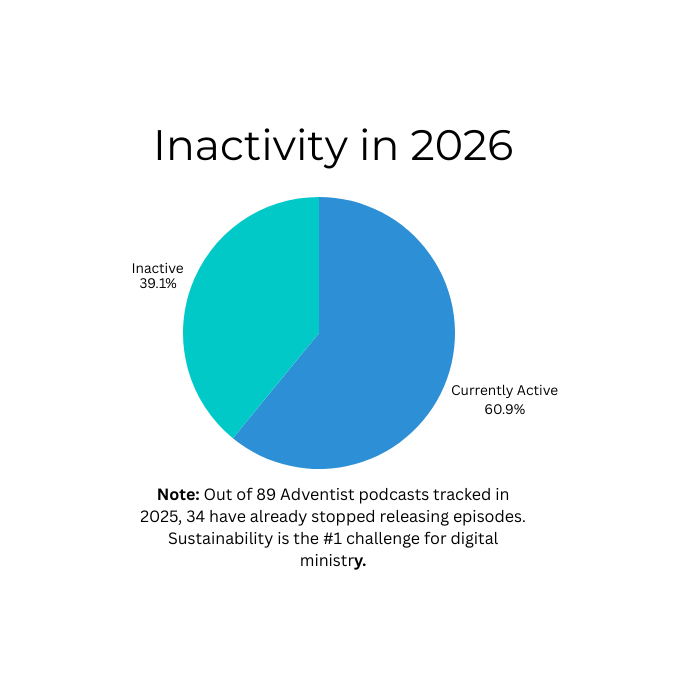
Data indicates a significant volatility within the medium. Of the 89 podcasts tracked over the last 12 months, 34 (approximately 39.1%) have ceased production.
The pause may not mean that our podcasters have completely stopped producing podcasts, but are gearing up for their next production cycle. Logistically speaking, podcasts can be challenging to pull off. And as a podcast production house we understand how much effort it takes to make a podcast successful.
We’re wondering, “Why do so many choose to stop?” We are currently investigating this to better understand the Ecosystem of Adventist Podcasts.
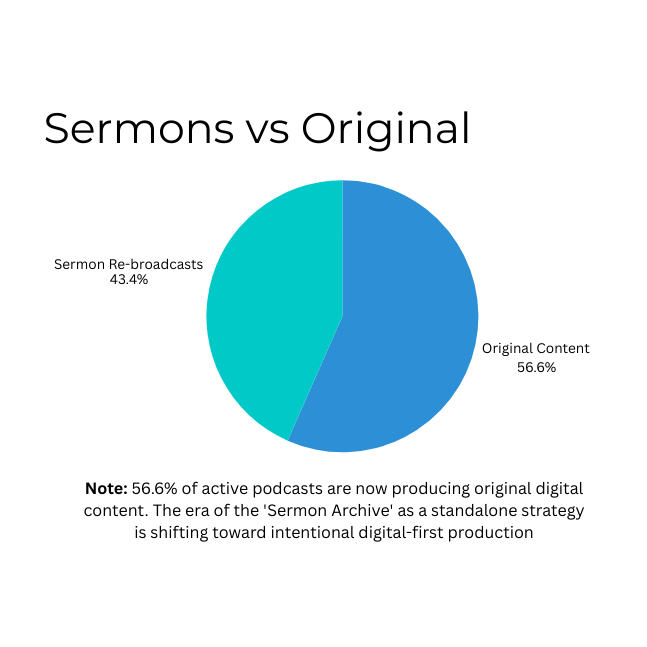
Currently, 43.4% of active Adventist podcasts (22 out of 54) are “Sermon Re-broadcasts”—simply uploading the Saturday morning audio to a feed.
While archiving sermons is important, it’s also a passive strategy. The data shows that the fastest-growing shows are using engaging podcast formats: Interviews, panels, narrative storytelling, and Sabbath School Bible studies.
To reach the “unchurched” or the “digital-first” generation, local churches need to adapt. They must evolve from broadcasting a service to producing a show. Podcasts need to be designed with intent to keep the attention of our audiences.
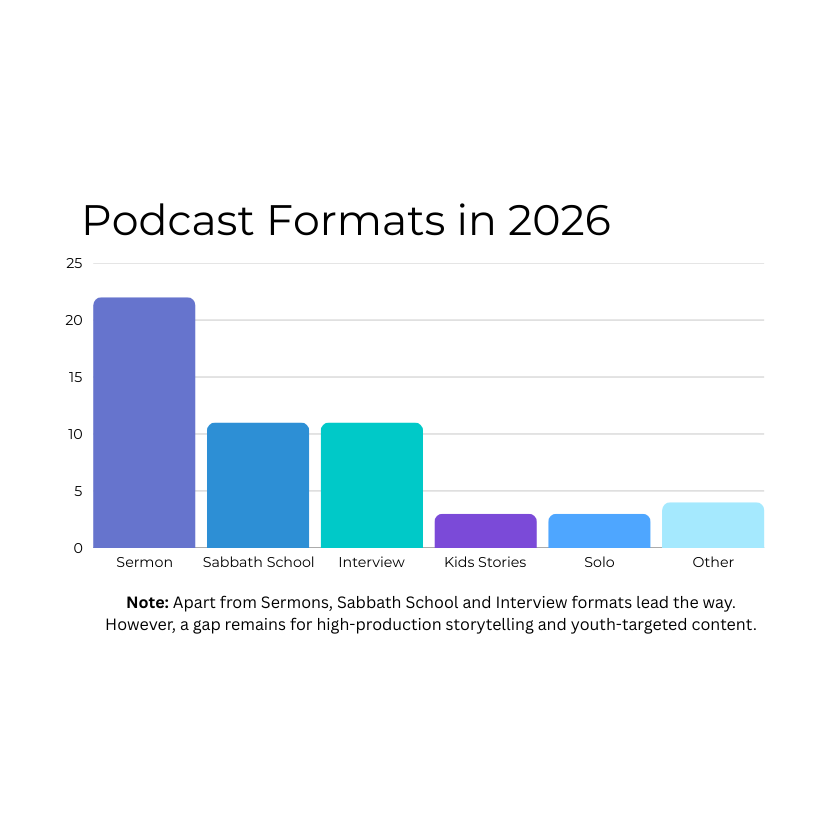
Sabbath School and deep-dive Bible Study formats currently represent the most widely produced category, apart from sermons. Programs like 3ABN’s Sabbath school Panel and Amazing Facts’ Sabbath School Study Hour continue to set the gold standard for Sabbath School podcasts.
The good news is Adventist podcasters are focusing on producing discipleship-focused audio. However, we see a gap in the data: while “Interview” and “Sabbath School” podcasts are well-represented, there is a shortage of high-production content specifically curated for the 18–35 demographic. This is the primary opportunity for growth in the coming year.
These ten shows are setting the standard for podcasts in 2026. They are ranked based on their production value, and overall production consistency.
| Rank | Podcast Name | Producer | Format | Why It’s a Leader |
| 1 | Discovery Mountain | Voice of Prophecy | Narrative/Stories | The gold standard for immersive audio drama and storytelling. |
| 2 | Frontier Missions Journal | Frontier Missions | Episodal Narrative | A rare and high-value example of mission-based storytelling. |
| 3 | Adventist Music | Blue Vineyard Audio | Interview | High-production interviews that provide deep value to a niche creative community. |
| 4 | The Story and Experience | Adventist Health | Interview | A rare and high-value example of serialised mission-based storytelling. |
| 5 | Papa’s Bible Stories | Church Member (Ind.) | Stories | A top-tier example of an independent creator filling the gap for kids’ content. |
| 6 | 3ABN Sabbath School Panel | 3ABN | Panel | Demonstrates the power of a stable, high-engagement panel discussion format. |
| 7 | Adventist Voices | Spectrum | Interview | Consistently bridges the gap between complex topics and engaging conversation. |
| 8 | Death to Life | Love Reality | Interview | High-relevance, life-application content that resonates with the 18–35 demographic. |
| 9 | The Aus Table Talk | Church Member (Ind.) | Panel | Professional institutional audio that prioritises high-quality guest experiences. |
| 10 | Adventist Pilgrimage | Adventist History | Interview | Masterfully uses the interview format to bring historical context to modern audiences. |
We think this shows something very important: The Adventist church has a message that the medium of podcasting is ready to carry. We are impressed at what’s being done and are looking forward to seeing what will happen in 2026 as more creators take up the calling to be digital missionaries.
Moving forward, the success of Adventist digital ministry will likely depend on two factors:
To reach a global audience effectively and sustainably, the gap between “mission” and “production” must be bridged with professional strategy and dedicated technical support.