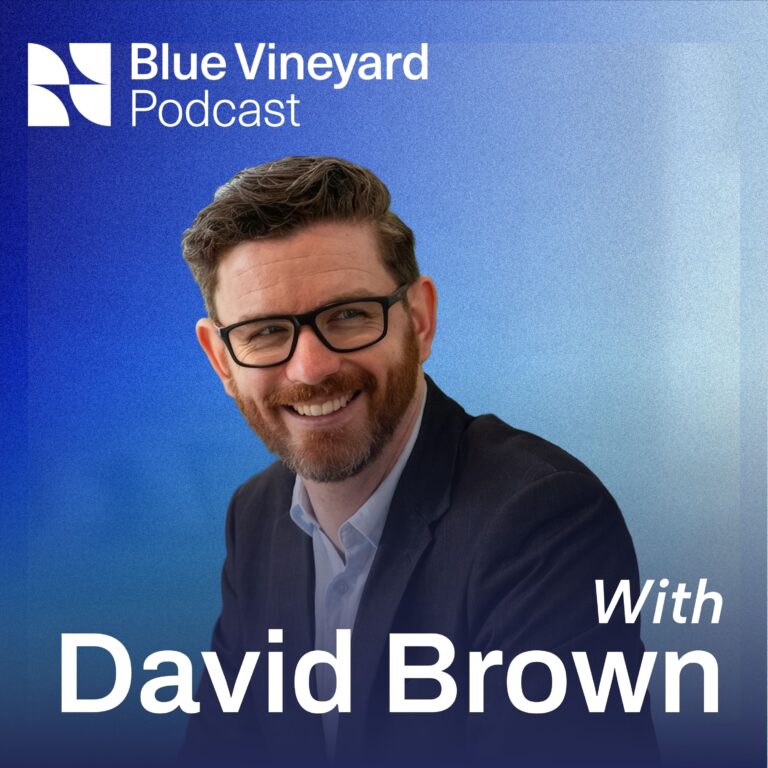
Meet Dave, one of the key minds behind Blue Vineyard. This is the first episode of our new “Humans of Blue Vineyard” series. In it, we sat down to explore the journey that shaped who he is today.
You’ll discover the path he took before he worked for Blue Vineyard. Each chapter left its mark on how he thinks and leads today. And what actually shifted his path from ministry to entrepreneurship to engineering. And the moment his work at Blue Vineyard became part of his calling.
Dave’s Recommended Books:
Thoughts from the Mount of Blessing, by Ellen G. White
Good to Great, by Jim Collins
7 Habits of Highly Effective People, by Steven Covey
CONNECT WITH BLUE VINEYARD
🔵 Subscribe, and join the discussion
🎙️ Audio Podcast: https://rss.com/podcasts/bluevineyard/
🌐 Website: https://bluevineyard.com
💼 LinkedIn: https://www.linkedin.com/company/blue-vineyard/
✉️ Get in touch: [email protected]
Episode transcript 7,612 words
and it became more than a part-time thing, it became a full-time thing, and now I feel like it's part of my calling as a person, is to help serve the Lord in this space. This is the beginning of a new series we are starting a series where we're going to be putting the spotlight on some of our internal team members and Showing you what makes them tick and also how they came to be working with us and it's going to be a really interesting series but as we thought the Best person to start with would be my like my longest friend in the company. And that is that is Dave. We've been friends far longer than Blue Vignette has been around.
So I thought just to just to get us started. The question that I wanted to ask you, Dave, is what is your memory of how you and I met? My memory of how we met was we were traveling through the area, stopped in at your family's house. You guys were very lovely, very hospitable, and you were very different than the kind of person that I typically hung out with.
Luke at the time had a ponytail and half a beard, just a little strip around his jaw. Yeah, so I guess I kind of like, yeah, probably judged the book by its cover and was like, oh, not sure we're going to get along super well. And then yeah, I guess over the evening, you know, we kind of hung out a little bit. And I remember in the early days being a little bit intimidated by you as a person.
So yeah, that's kind of like my memory of first impressions. Now, this story is about you, Dave, but I will say the feeling was mutual. I didn't look at you and think you seemed odd, but I definitely felt very intimidated by you because I was in a tiny regional church and I was kind of like the really spiritually engaged young adult archetype for my community, and this other guy who came who's like four years younger than me or whatever you are, and this guy is like... you know, really respected and speaking and all the rest of it. And I'm like, oh, he's doing what I'm doing, but he's just doing it like five years earlier.
And so I was feeling really intimidated as well. It took us ages to get past that. Yeah, that's awesome. I love hearing how like you guys, you know, started your your friendship.
And that's one of the cool things about business and entrepreneurship is you get to work with people that you like. You don't have to work with people that you don't like. It's pretty great. So one thing I want to work a little bit backwards here and just like.
Zooming out a little bit like I would love to hear your description of what you do at Blue Vineyard Like what what do you do? I? Don't know the simplest way that I describe what I do is that I am aware of many hats Yeah, I guess you know our company has been growing and as your company grows your responsibility shift right and so Yeah, it started out pretty simple and then became rather complex and has grown in complexity. And now I think it's just starting to turn towards simplifying again.
Yeah, along the way, I've worn many hats from, you know, project management to bookkeeping to, yeah, managing operations looks at product lead, you know, all of the rest of it. Yeah, I've learned a lot. It's been great. You mentioned that you have learned a lot in that in that process.
Maybe if you, you know, take a little step back because, you know, you weren't always in the technology space. Can you just walk me through perhaps a couple of the chapters that you've walked through professionally in your life? Yeah, how long have you got? Hours.
Yeah, so I think, you know, life is not often linear, but mine has certainly not been. So I finished. Well, I didn't finish. I left high school when I was 16. and started an apprenticeship.
So that was my first job. Well, my first adult job, let's say. And so that apprenticeship was in as a fitter and machinist. So I was working with metal.
We were building sawmills at the company that I was working for. I really enjoyed that because fitting and machining is quite like you have to it's quite. fine tolerances that you work to. So you have to be very careful and intentional with what you're doing. So that was fun.
But I actually only stayed in the apprenticeship for just over a year. And during that year, God shook up my life. I had an experience where, yeah, I guess I everything shifted and what was my parents religion became mine. And I felt called to go to a Bible school.
So that was in 2009. And yeah, so the next chapter of my life was in sort of volunteer ministry as a Bible worker, a Bible teacher, you know, helping to run certain components at the Bible school that I was trained at a few years down the track back to Bible work again. So a lot of like church ministry, as Luke mentioned, you know, did the circuit preaching. I was involved in, you know, sort of teaching ministries throughout that time.
And so yeah, I guess I would say during that time of my life it was all about like, you know, just like sharing with other people the the joy that I had found in in a scripture and my relationship with God and trying to point them to Yeah, how they could have the abundance that I was starting to experience that became unsustainable for me after a time because I took it on very internally took on the pressure of doing ministry with people. And ministry with people is always messy. So I decided to sort of take a step away from the church ministry as a vocation and just keep it as my passion on the side. And so I was like, well, what will I do?
And I had been enjoying working in the Ag department at the Bible college that I studied at. So I started a business doing landscape gardening. And this is probably the first time where Luke and I started to kind of connect around business, because he was helping me with my design. And one of the pieces of advice that he gave me was that I need to put my prices up, things like this.
And yeah, so I tried that out, but the business that I chose was quite niche because I wanted to help people. And so the landscape gardening was around like, you know, edible landscapes and lifestyle. And I was in a low socioeconomic community and that just didn't really work there. So I tried that for a while and then just needed to pay off my debts.
So I just went and found whatever job I could find. There's actually a cool story behind that, but maybe that's a story for another time. And I was just working in an office at an appliance repair place for a while. That was kind of my first introduction to office work because I've been quite hands on before that.
And so, yeah, I started kind of as like a general sort of secretarial kind of role. And before long, I was pretty much just managing the office. And I got so bored there that I was like, I need to do something different. So I went to my happy place, which is in the bush.
I went for a walk, you know, in the mountainous region and I was just praying about what to do next and yeah God sort of you know threw a series of events that again is a whole story in itself led me to going back to school right I started an engineering degree at university and because I didn't finish high school I had to do a bridging course first to actually make it possible for the university to accept me so that was a that was a long slog it was five years including the bridging course of full-time study whilst doing full-time to part-time work throughout. And so, yeah, those were some solid, you know, slog years. And during that time, something you may want to press on potentially, the thing I had to overcome was I felt like a high school dropout. Like, that's how I defined myself.
And so going to university was quite a fear for me. And so I had to actually overcome this, like, insecurity about myself through those years. And that took probably four and a half of those five years to overcome. So yeah, that was me.
So I did a degree in civil and humanitarian engineering, which is essentially problem solving for a specific context. And then I wound up looking for a part-time job because I wanted to do some post-grad studies around solving homelessness, which is something that we can talk about as well if you like. And I just needed part-time gig and I knew Luke was trying to get this business going and I was like, hey, I'd love to help you. Can I have some part-time work to help you with the project management?
Because, you know, when we do this same thing for him, I'm sure we'll learn that he needs somebody to help him in that space. And yeah, so that's that's kind of where this started. And it became more than a part time thing. It became a full time thing.
And now I feel like it's part of my calling as a person is to, you know, help serve the Lord in this space. So, yeah. Sorry, circuitous journey. But you asked the question.
No, it's a great circuitous journey. And Yeah, so many of us have, you know, I always think, you know, think like dominoes and like, you know, like dominoes, sometimes like they go off to one way or they go out to the other. And you never know, like, all right, if I if I push this domino down, like, what's that end result going to be? And there's no real good way to know how that that's going to end up.
And it's fun to see like, yeah, you were talking about thinking of yourself as a high school dropout. And then in like engineering, engineering is not for the for the faint of heart. How was what you learned both from, you know, feeling as like a high school dropout, all the way to doing an engineering degree. How does that apply to what you're doing at at Blue Vineyard?
Yeah, great question. And maybe something I want to I want to point out about my journey, just in case anybody's like seeing some resonance with their own journey, is that after I had my experience with God, the common denominator with all of the jobs that I was doing was was people. And I think I found my passion early and I just didn't realize it yet, which was I wanted to be building relationships with people. And how that relates back to your question about engineering is interesting, right?
Because you don't typically think of engineering as a people-facing profession. And yet my motivation for going into engineering was that I had a specific problem that I wanted to solve and I felt engineering would help me to get there. But interestingly enough, I learned skills during that degree, which apply. in so many other places in my life, beyond what I had imagined, which is another sort of life lesson that to me, I just think is really important for us to learn that we might define a particular path that we think, this is what I want to do with my life. And in striving to meet those goals, we often find other goals that we're like, oh, actually, this applies here as well.
As I said, engineering is just glorified problem solving, right? Like it's very intense and technical, like you said. That was a really tough course for me, particularly because it had been so long since I'd done high school math. And so, yeah, I kind of had to like learn some things really quickly to set some foundations that, you know, for the kids who were coming straight out of school, they were like, oh, this is easy.
What are you talking about? But then on the other hand, as a mature age student, I brought life lessons and understanding of how these things were valuable in practice that the kids didn't have. Anyway, so I think what I would say in answer to your question is that the first principle's nature of engineering is that we're always trying to pull back to what is the foundation of this problem. Because if we can fully understand the foundation, then we can solve up from there.
That applies in every facet of your life really, although it can be a bit troublesome in human relationships, particularly marriage. Yeah, like in my job now, I am I'm doing problem solving. And so I have great frameworks that enable me to to do that, I would suggest probably more quickly than most people. And so when you have to make split decisions, you know, as a leader in an organization, and you have to make judgment calls frequently, it's nice to have a base to know that you're not just going, you know, with your gut, without having, you know, some sort of substantiated reason.
Yeah, and I think the other thing too about that is that that provides a nice balance for the people that you work with, right? Not everyone needs to function the way that I function, but because not everyone functions the way I function, we all bring a valuable perspective to the table and that contribution makes us work as a team. As you were describing that shift or that change in how... how you viewed yourself and then how you carried that into the work. I can speak from the perspective of your friend.
You are still Dave, the same Dave as before you went through that process, but you are definitely a significantly sharper version of that version of Dave. By doing the hard things, you've acquired I think much more confidence in your own ability to do those things, because you're more confident, even though you were very intelligent beforehand, you got to the place where you identified with, oh, I actually can do this. And I am actually an A player. I am operating at that level.
And when you sort of accept that, then of course, you're going to act in harmony with that. And when I said, yeah, Dave, let's do this, and you started doing the project management. I observed the same thing happened here in Blue Vineyard that happened at your office job that you had, right? You came in in a limited capacity, but because your skills are so much broader than that, it was like, oh, well, I'll also do this and I'll also do this and I'll also do this until the job is Dave-shaped, right?
Somewhere in there, you said that you now consider this a part of your identity, right? I'm curious if you... Can you pinpoint? What was it about the work that we were doing that went from you saying, oh, this is something that I'm doing to help a friend for a bit of part-time work.
What shifted in your head to say, actually, this is a part of my mission, and I'm on this mission as well? Yeah, it's a good question. And I think it probably happened without me realizing it. But I know the day when it clicked for me that it had happened.
But I can't tell you how it happened, right? So the day that it clicked was I was sitting in church one Sabbath and the preacher, good friend of mine, Robbie, was talking about, you know, what you have in your hand, right? And how we can serve God with what we have, right? And I was reflecting upon that and thinking about what I had in my hand.
And one of the most substantial things I had in my hand at the time was, you know, working here at Blue Vineyard. And how I was utilizing the sort of unique gifts and perspectives that God has given to me in this role for this company. Yeah, it just kind of clicked for me that, oh, you know, what I'm doing here is not just a job and what we're doing here for Blue Vineyard is not just a commercial enterprise. This is the expression of what I've been wanting to do with my life all along, which is to make a difference in the world, to impact the world with truth.
And that truth doesn't always have to be explicitly Jesus. shaped. Sometimes it is implicitly right, like we don't necessarily have to be doing a Christian thing to have, you know, a Christ-like influence on those around us. And so, yeah, I guess it just kind of clicked for me that this is not just a job anymore. This is now, it feels like, as much of my calling as, you know, the other thing that I was initially pursuing and felt was a calling from the Lord.
And so, you know, the way that I would describe it is that I came into Blue Vineyard looking to pursue your vision, Luke, and then over time your vision has become my vision, right? our vision, right? We now share the vision for what Blue Vineyard can be. And I'm fully bought into that and it's no longer me trying to make your business successful, but now it's like, hey, let's do this thing together. And together, let's create something that is bigger than each of the parts that are involved in it.
That's awesome. I love that, how you said that like, It's now our our vision. And that's that's such an important part of an organization is that that that vision spreads. So I'm going to kind of get off some of the philosophical, you know, it's fun, but I want to get to some other.
This is a practical question because of your background as an engineer. I feel that you have cultivated a specific. tech stack, like list of tools, like things that you use that, you know, make you, help you do your job better. Obviously there's tons of software, tons of things that you could, you know, list off. But what are some of the different items that, wow, I just, I'm so glad I have this piece of software or like this computer.
Like what are some of the things that you use that help you do your job as well as you do in Blue Vineyard? Well, the thing I learned as an engineer is that your most important tool is actually not a piece of software. It's the pencil in your hand, right? Or, you know, pen, whatever.
I think first place is always, I like to scribble. You know, and so, you know, when we're having a conversation, I might be taking some notes or I might be, you know, like sketching something out, right, like a concept or a diagram or something, because that helps to solidify the thoughts. So I think the first thing is like reflective practice. And that happens through note taking or through some kind of like taking what you're thinking about processing and then putting it down somehow.
One of the ways that I do that is with just speaking and a revolutionary tool that I've been using for quite some time now is Whisper Flow, which, you know, there's all sorts of voice to text tools out there. And so, you know, pick the one that works for you. What started happening for me was I was getting so busy that I just had there was just no way I was going to be able to, you know, write out replies to everybody, you know, that I was working with. And so I started using Whisper Flow as a trial to see if it would improve my efficiency.
And it started to improve my efficiency significantly. But then like my use of the tool evolved and the second most useful piece of software that I use right now is Claude, so Anthropics AI tool. And the way that those two things combine is that, you know, I would say that Claude's internal voice model isn't that good. So like I used to with chat GPT, I used to, you know, just uh, switch the voice mode on and just have a conversation with Claude.
I don't feel as confident to do that. And so what I'll do is instead I'll open whisper flow and I will use the voice to text function to, to share my thoughts, um, you know, into Claude, uh, and either use it as a brainstorming partner or you can get stuff done. Right. But, um, with, with AI, what I've learned is that your, your outputs are only ever as good as your inputs.
And the more nuance you can give with your input, the more the more U-shaped the output is going to be. And of course, sometimes you don't want the output U-shaped. Sometimes you want actually it to grow you as a person. And so sometimes it's best not to give too much as an input.
But if you're wanting it to do something for you that represents you, you want to give it as much nuance as possible. And so using those tools together has been a game changer for me. And I think the outputs that I get now from AI as a starting place that we then, you know, it's always important to have a really strong human in loop with your use of AI. And so it's not that I rely upon it, but it does take out a huge chunk of the time consuming work.
If I can even just like, I wanna develop a project plan for a project and I just open Whisperflow and I talk for five minutes, just stream of consciousness. These are all the things we need to do. Organize my thoughts and make a plan for me that I can then review and then you know Make changes to and publish like that process might save me, you know hours So yeah, those are some of the ones that come to mind Adam One of the other things that I was thinking about because you you you have worked in a ministry sense but before working with blue then you you have you had not worked with like the The larger scale like Adventist organizations, you know, you know internet internationally and all of those things In doing that, what have been some of the things about the church or about how the church uses technology that you found to be the most surprising? Oh, bro, are you trying to throw me under the bus here?
I'm just trying to give the people what they want, Dave. Just trying to give the people what they want. Look, I mean, I guess everyone's going to come into a situation and we're going to bring our own biases, right? So, you know, I come from a certain background and I look at it from a certain lens and I get frustrated by things, right?
And probably everybody has their own unique frustrations with the processes, right? And so whatever I would recommend probably isn't necessarily the solution. It's just something that is how I would approach the situation. I think something that surprises me in both ministries and like the organized church is that sometimes we don't empower people to fulfill the role that they've been employed to or called to do.
And that is perhaps sometimes about education, and then sometimes it's even about selection. Yeah, I would love to see us be more pragmatic about how we either educate people for the role that we give them. And so, like, because we want them to succeed, right? And some people are placed in roles and it's just like, fish out of water, I don't know what to do here.
And we still expect them to succeed in that role, you know, to deliver on the KPIs that we set out. And I just feel that that's a little bit unfair on some of our really good people, you know, that are just in the wrong seat. Right. And so sometimes it's about like educating them well.
And then sometimes it's just about like, let's be pragmatic about who we select for what role and select people based upon the outcomes that we need to achieve rather than, you know, whether they have done good ministry in the past or whatever. because I think there are some people who are fantastic pastors, preachers, people who are great at connecting with people. And then we place them in a role that isn't suited to their skill set. So that's, I guess, a bugbear. It could be though, my own blind spot could be that there is a dearth of people who are actually qualified for those roles.
And so maybe it's just a matter of we don't have the people, in which case then education would be my solution to that problem. Something else I've been surprised by in some places that I've been involved in projects with is a very strong top-down leadership models, which... Yeah, I don't know. Maybe again, this is my own personal bias, but I've just never seen that be a super successful model for getting the best out of your people.
I think when we give people trust and we allow people to excel in the ways that we have asked them to excel, then we get a better outcome. Whereas if we are asking them to do a job and then telling them how to do that job, we're really limiting those people. Yeah, so that's something that, by the way, I appreciate about our business, you know, we're still growing, of course, but we try to have this, you know, we try to allow people to make mistakes, you know, whatever on their own and learn and grow and we support them and we provide them with what they need to grow as people and professionals. But at the end of the day, if we do their job for them, then they're not growing as a person.
So that's something that I would love to see ministries and church organizations just be a little bit more intentional about. Let's let people excel in the roles that they're given. You have a lot of things professionally that you have to be proud of. Different accomplishments in the work.
I'd love to just divert a little bit. What is something non-work related or several things that you are proud of? Maybe it's a hobby, maybe something you've accomplished, something that's non-work related that you're proud of. As I said, I would say my core value is relationships.
I think people are the stuff of life. And so what I'm most proud of are the people around me. you know, really proud of my wife. I think she does excellent work. She does it so diligently.
And I'm just so grateful for the way that she leans into the challenges that she has and just makes such a difference in the ecosystem in which she works as a chaplain and a counselor. And so, yeah, correspondingly, I guess I'm proud to have made that connection and to be able to do life with her. I'm really proud as well of the, and this is something that is always, I think, an area that I'm always learning and growing in, right? So I'm proud of where I've gotten to, but certainly see room for improvement.
I'm proud of what God has done in me as a person in shaping me to be, to choose to listen first and respond later. I think that that's a really important value, and it's something that I certainly didn't have as a young person. And I feel like as I've grown as a person over time, that's something that has become a core value to me that people's perspectives are far more valuable than we give people credit, than we give credit to. Maybe I didn't say that right, but anyway, you got what I mean.
Yeah, no, I get it. Yeah. Yeah. And so as such, the best way to extract that value is to listen well and to be curious.
And so, yeah, I'm proud of that being a part of who I am. I don't really have anything else to share in that vein, Adam. Like there's not a lot of hobbies in my life right now, so I can't really share any pride moments of that. Maybe ask me again in five years.
Being the husband that you are, being proud of that. Fantastic and amazing. So, yeah, great answer. I do want to pull on a thread from earlier in our discussion day.
You were mentioning, you know, the your initial thinking of your of your calling and, you know, in the the homelessness space. And I just wanted to go back to that because I that's something that is still on your radar. And I think it's something that really matters. And so it also intersects with what you were just saying about your you know, people being the stuff of life and, you know, so I'm curious just to lay that out a little bit.
What is your vision in that respect? So look, a long, long time ago, I'm gonna guess it would have been from memory probably in 2011. So what's that? 15 years ago. My goodness.
I was reading a book and there was this chapter in the book which talked about how we can help the unemployed and the homeless and For some reason, you know, I've never had an experience where I've struggled with unemployment or where I've been homeless, right? So For some reason, this just tugs so deeply on my heart that I just knew this was what I wanted to do with my life was solving this challenge in the community that I live in. And I find that strange because since working in that space a bit, I have realized that most of the people who are working in that space have had an experience of homelessness, and that's why they're passionate about it. And so I don't know. what it was.
And maybe one day, I guess it might become clear why why God chose to put that on my heart so deeply. But yeah, for some reason, that became something that was really, really significant to me. And I just knew I had to do something about it. And so, yeah, the elevator pitch is, I believe that homelessness is solved primarily through education.
And I don't mean in the conventional sense of go to school. I mean in the sense that homelessness is essentially a problem of dependence upon something outside of yourself that is quite limited, I guess you would say, in Australia at least, right? This is the context I know. And so for us here in Australia, we have a great social welfare system in a sense.
And so people are reliant upon that system. But they're reliant upon that system and they're... they are unable to be independent from the system. What you are essentially trying to do is take someone from a place of dependence to a place of independence. And so I believe the route to get them from one to the other is through education.
And that can be social education, that can be mental health education. And in that sense, I guess it's more healing than education, but rewiring your brain because a lot of people who struggle with homelessness have either ended up as homeless because of a mental health challenge or have experienced mental health challenges as a result of being homeless. Anyway, so education being the bridge to get them from dependence to independence. And I believe that that is best achieved through an integrated support system.
And I went and studied engineering because I believed that it is both a social and an engineering problem. And most of the frameworks that I've seen around homelessness either deal with one or the other. We either think it's a social problem, so let's solve it socially, or it's an engineering problem, so let's solve it with bricks and mortar. And my feeling is that it is not one or the other, it's both.
And so what we need is an integrated holistic solution that provides an opportunity for people to be provided with the social support and the right social dynamic to grow, but through a novel approach using engineering. And that novel approach is what I was going to spend my time studying and learning. and implementing in the community. What a wonderful like, you know, just life kind of vision and you know, the like saying like, yeah, no, we can, we can, we can do better. Like we can make a dent on this.
I love that ambition. And I think that's fantastic and something that we can all learn from. In the theme of ambition and big things. If you could, you know, we've worked, you know, I've worked on some, you know, large ministries.
Do you have like an ideal, like, if you could get a project from like, from any organization, any company, what, who would you like to work with the most? Well, I am passionate about, I'm probably most passionate about two aspects of life, let's call it, and those are education and ministry. And so either a large-scale education product that would reshape the landscape of education to move us from a place where we have these approaches that are deficient because they are so standardized and cookie-cutter, and that doesn't work from my personal experience as a teacher. and move us toward a place where we can achieve mastery for all students, not just those that fit into our mold. So either that or a project that would have the capacity to reshape the way that the Adventist Church approaches ministry, so that ministry would be about the whole person rather than just aspects of the person.
It's my view that When we read the gospel stories about Jesus in his ministry, Jesus wasn't doing ministry in a single dimension. He was always aware of and ministering to the whole person. So that being the spiritual needs, yes, but also the physical, emotional, social needs as well. I believe that ministry should be approached in that way.
And our goal shouldn't just be convert a person to a specific religious framework, but actually to take a person from a place of need in whatever facet of need to a place of abundance. And I believe that abundance only really happens when we get all of the ingredients together and we approach ministry holistically. So those it's not really an organization, Adam, because I think I would rather just think organizationally agnostic. It doesn't matter who does the work.
But I think those are two projects that I would feel really passionate about being a part of. Because I think that, you know, the next generation is shaped by education. And so, you know, making a difference there is so important. And even when I say the next generation, like if we're talking universities as well, that's like a pretty immediate impact.
And then, yeah, from a ministry standpoint. That's something that I think we should have been doing it hundreds of years ago, if I'm really honest, but we should be doing that now. So I'd love to see that solved by whoever's ambitious enough. And I would love to partner with them on whatever that thing is.
Love it. Let's do it. Dave, with your experience being so multifaceted, education has been a theme here, right? But a key factor of learning anything is the willingness to have, you know, failures.
And you mentioned before, one of the things that we strive to do in our team is give people the space to take ownership of things and to fail when necessary and to grow from that and be supported, you know, in order to grow with that. I'm curious, in your experience, what stands out as a significant failure that you learned the most from and perhaps what did you learn from? Yeah. So in business, they say fail fast, right?
That that's a That's the secret. I think some of the things that I've learned over time is the pain of not failing fast. So if you if something isn't working and you try to make it work for too long, yeah, that can be tough and painful. Yes.
Specifically, though, what have I learned from failure? And it's funny because I don't really define anything as failure. So I'm trying to think through how I can reframe that. So I learned some things in every one of the disciplines that I've worked in that have shaped me as a person.
And so, you know, you might look at dropping out of school as a failure, but really it wasn't because it moved me into the workforce and into a maturation process. sooner, so that when I was able to, you know, jump into other roles, I had more life experience than any other person who was applying for that job. Because I, yeah, I had done so many things at a young age. So like, by the time I was like 21, I had probably done like five different things with my life, right? Which meant that I had a breadth of experience and a breadth of perspective that made me useful.
So unless you're looking for a specialist, I was probably a really valuable person to have on your team because I had that breadth of experience. So that's something that I learned early in my life was that each chapter is valuable and you take the lessons you learned from the chapter previous and you apply them and you grow and you add, right? the business that I started that failed, let's call it failed. What did I learn from that? Oh, so many lessons that helped me today.
And ultimately, I think as I survey my life, what I've learned is that when you try to put a square peg in a round hole, that doesn't work, right? And so I think what I was probably trying to pursue all along was entrepreneurship. But I hadn't realized that for a fair while in my life. And so I was trying to fit into structures that just didn't fit for me as a person.
Anyway, sorry, you're going to ask. I just wanted to jump in here. One of the first things you said in the answer to that question was that you don't really define anything in your life as a failure. I think that is a really curious psychological construct. all by itself.
And so I was just wondering if you would be able to just elaborate on that a little bit. Yep. Okay. So I think that rather than viewing things as failure, we view them as opportunities to grow and that is an opportunity to grow through learning, right?
So when something doesn't work out the way you intended it to work out, rather than, you know, coming from a place of woe is me, this didn't work out, we take a step back and we say, what can I learn from this situation? And how can this situation then grow me as a person? So yeah, that's kind of the framework that I approach things through in a simple way. That's great as we're getting close on time on a few few questions here as we're winding down books Could you give us some book recommendations that have been influential in in your life?
Yes, definitely so many So I was thinking about this earlier in terms of like maybe categorization. So from a spiritual place, one of the books I would say that was probably most impactful in shaping me was a book called Thoughts from the Mount of Blessing, which is a commentary on the Sermon on the Mount, which is probably the greatest sermon that has ever been preached. And so I feel like you can learn basically everything you need to know about being a Christian from the Sermon on the Mount. And this commentary just happens to be a great exponent of that sermon.
So love that book. It's punchy as well. So it doesn't take you long to read, but it will kick you in the guts. And I like it with kicking the guts.
On a business and leadership. side, I would say a book that I didn't read this too long ago, really, this would have been like maybe three years ago or two years ago or something is the book Good to Great by Jim Collins. I think that is a really balanced way of understanding the value of leadership. And it's super helpful in business. One of the things that I particularly like about his framework for leadership is the nuance that Good leaders are also empathetic leaders.
And I think that that's a really important element of leadership. It's not about being a dictator. It's often about listening well. And then maybe I'll throw in a life one as well.
There's probably many others that I could share, but a life one that I think is really valuable just as a person is Seven Habits of Highly Effective People. I think everyone should read that book. This is going to be a difficult question for some to put together, but for you personally, Dave, if you had to define the key thing, what is your superpower, the thing that makes you uniquely qualified, what would that thing be? Yeah.
Well, I would challenge the assumption that it's unique to me. I would say that what I consider to be my greatest superpower isn't unique to me, but actually is probably the greatest superpower for humanity to possess, and it's the ability to listen effectively. I think our attention is the most important commodity that we have. So giving somebody else our full and undivided attention is like probably the most significant gift we could give them, right?
I think feeling heard and understood is a core human need. And so gifting this to someone by taking the time to hear them well, I think would make a bigger difference to them than any wise thing that we might have said before we listened well. So I would say that's something that I've tried to cultivate as a superpower. Maybe I don't always get it right, but that's something that I would suggest is a strength for me now because of intentional effort.
What a great question to end on. That is such a fantastic and apt descriptor as a podcast and listening is what we do in this podcast. Dave, thank you so much for sharing these thoughts as we wrap up. Is there any encouragement that you would like to give our listeners?
Yeah, you know, it sounds super cliche, right? You know, stay true to yourself. You know, it seems like you could hear that in Hollywood. But I actually think that that's so true.
You know, like you are a certain shape of person, right? Like God has blessed you with some specific attributes that are unique to you. And if you try to redefine yourself to please somebody else, my experience has been that that doesn't always bode well for you as a person. So I think it would be lean into who you were created to be, be the best version. of that person and not somebody else's version of you.
And yeah, like, you know, if you, if you can do that, I believe that, you know, God is going to, you know, excuse language, but enable you to kick some butt in whatever area of life or ministry you happen to be in. Thank you, Dave. Language excused. Awesome.
That's great. Well, we will leave that there. Thank you, Dave, so much for your time. We will be doing more of these episodes with our team members in the future.
And if you enjoy that, please let us know. We look forward to bringing you the next episode soon. So until then, God bless and we'll see you then.
Transcript is automatically generated and may contain errors.