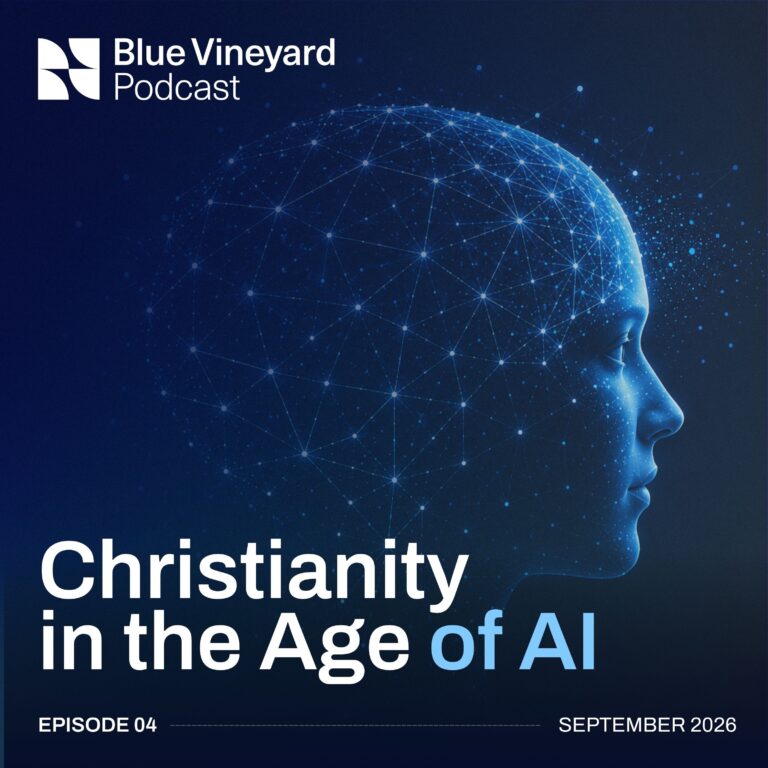
In this episode, Luke and Adam react to some hot takes about A.I. They discuss Adam’s latest sermon called “Christianity in the age of AI”. And they try to reconcile seemingly conflicting viewpoints on the topic.
This is Episode 1 of AI in the Age of Christianity, a series where Luke and Adam bring in guests, explore the hard questions, and work toward a framework the church can actually use.
TIMESTAMPS
00:01:00 Why AI keeps finding its way into every conversation
00:02:00 Adam’s sermon research and the rabbit hole it opened
00:03:00 Clip 1: “We Are Building God With AI”
00:07:00 Is treating AI like a god a form of idolatry?
00:09:00 Clip 2: The $800 million biohacker building gods
00:12:00 Clip 3: Midwifing a deity
00:16:00 Clip 4: Tucker Carlson and the trillion-dollar question
00:17:00 An Adventist lens on AI and prophecy
00:18:00 How much does Claude already know about you?
00:21:00 The Pope, the encyclical, and the Tower of Babel
00:22:00 Announcing the series: AI in the Age of Christianity
MEET YOUR HOSTS
Luke Farrugia is the co-founder and CEO of Blue Vineyard, a family of digital technology companies built to serve mission-driven and Adventist organisations. He’s got 17+ years in web design and consulting. Luke brought his expertise into the Adventist digital space and is building an ecosystem of digital specialists.
Connect with Luke on LinkedIn: https://www.linkedin.com/in/lukefarrugia
Adam Weeks serves on the pastoral staff at Auburn Seventh-day Adventist Church in Northern California. He also works on the team at Blue Vineyard.
Watch Adam’s sermon on AI: https://fb.watch/HJQj5Kw6mq/?mibextid=wwXIfr
CONNECT WITH BLUE VINEYARD
Subscribe for more insights on faith and technology
Youtube – https://www.youtube.com/@BlueVineyard
Website — https://bluevineyard.com
LinkedIn — https://www.linkedin.com/company/blue-vineyard/
Get in touch — [email protected]
Episode transcript 4,172 words
Is this going to end the world? Is this evil? And I get text messages from... Luke, I have been scouring the internet and I have found a ridiculous amount of information.
There's so much. But that is idolatry, right? If you're using it in that way, how is that any different from the people that we read about in the Bible? So, Adam.
I've been thinking about the recent episodes of this podcast, right? Doesn't matter what topic we start with, we always seem to end up talking about AI, right? It doesn't matter where we go. We always end up there.
As I've been thinking about this, because I get text messages from family members saying, is this going to end the world? Is this evil? And I get text messages from other people that are saying, hey, check this out. You know, AI is like changing my life and it's been so good for these reasons.
There are these like vastly different viewpoints on it. And I've been really sitting with it myself, trying to figure out how can I both have the right perspective myself, but also express that to others? Like, I don't know, how do you think is the best way to wrestle with that? Oh, man.
Luke the timing is really interesting that that you bring this up because I don't know if you know but so I am on the pastoral staff here at the Auburn Seventh-day Adventist Church and I'm in Northern California here in the U.S. Yep here we go and I get to do sermons I'm actually asked like every other month I need to do a sermon and I have been asked, hey, Adam, you've been messing with this AI stuff for quite a while, and would you be able to speak on that, to preach on that? And so, Luke, I have been scouring the internet and I have found a ridiculous amount of information. There's so much. information about Christianity and AI and what's happening and a lot of his contradictory.
And actually I found some kind of crazy clips on the internet. Do you think it would make sense for us to have a conversation and maybe through this muck and mire of what we can find on the internet, maybe we can work together and actually help me with the sermon. I think that sounds like fun. I I love crazy things fan on the internet.
So I'd love to see some of them if you all right So we've got some crazy stuff. Let's go ahead and we're gonna start the first one here and we're gonna set the scene It's kind of odd better or worse. We are creating a God it is it is on its way something that is as as powerful as what You know, all the religious scriptures talk about a god being able to do. That's been created, and it's still a big question mark.
Whether it's a good god or a bad god, whether it's an angel, you know, or a demon. And that both of these, we're at a fork, and those are both still possible. We can do better here. We can actually solve this problem.
You know, the asteroid is coming, but we can maybe deflect it. And by the way, that asteroid also might land on Earth and solve all of our problems. So the title of that is we are building God with AI. Agree or disagree, Luke?
I would fundamentally disagree with that statement. I think that you've got to start from a very low bar of what God is, if you're going to assert that. Let me start there. Yeah.
When he said capable of all the same things that the biblical gods can do. I got jammed on that for quite a moment there because that is a very, very significant stretch. that is something that people are putting some of these God-like ideas of AI. They are truly fearful or in awe, because these models are doing some incredible things. And one of the things that we keep talking about when we talk about AI is that this is the worst it will ever be, right?
Like the AI that we have today is as bad as it's ever going to be, and it's only going to get better And it's exponentially going to get better. And it's kind of how we've been talking about this. Can I interrupt there? Do you personally think that it is an exponential curve from here?
So this is what I believe. As I don't think that the technology is exponential and in similar ways that the light bulb wasn't exponentially better. The light bulb like. it turned on and then there were like infinite number of refinements of the light bulb. The very first light bulb turned on and turned off.
Like that's what it did. It provided light. I think AI will be in similar ways. When people first started it, it was kind of this like novelty thing and they didn't really know what to do with the light bulb and it was just kind of like a magic trick type of thing.
We've got candles for that. Yeah, we got we were good, but then we're like, oh wait We can use it for this and for this and for this and for this we found out there's this huge leap forward of safe light inside of a building Whereas before it was unsafe light because fire was unsafe for you know things would light on fire But now we can use it in so many more ways than we ever thought possible I think would be similar with AI is we're still figuring out how to use all of this stuff, but the basic technology is there. So I don't think the technology is going to be, you know, exponential, but in five years, we will be using it a lot different than we are today. One of the things that I think will change is the fact that we won't think of it as being AI anymore in the same way that we don't really think about electricity being the thing that is driving phones and traffic lights and all the rest of it.
We think of it, oh, it's a traffic light or this is this service is what I have. It will be so baked into the substrate of what the world is around us. We will just see it like a service like we see electricity as a service. Now, that's my hunch.
There are some complications to that that I think we can explore. And this this conversation, I think, is going to have many parts. But the I think there is definitely dangers like that. I'm not discounting any of that, but I think that's the role it's going to play in society.
What I wanted to speak to about one of the things that he said regarding it being a God, you know, you, you've probably heard as well, you know, there, there's these stories of people that grow an attachment to their AI, you know, where they build relationships with them or want to marry their, their AI companions and things like this. When I saw that, I was like, this is crazy, but this is uh, a problem for the people that are not aware, right? The people who are, um, you know, perhaps young, immature, and you're looking for connection and they find a connection and, you know, that's sort of the way that happens. I had that in my mind as something that only people that, uh, at some kind of reduced capacity or a level of immaturity would, would succumb to.
But what he's saying and what an increasing number of people are doing is treating AI like it is a person that. you could relate to as a God, right? You know, and so I think that's really interesting that we're sort of we're anthropomorphizing AI at a rate where people can treat it like a God and have outcomes that they kind of expect, you know, that it's a weird thing that we are, in a sense, we can create a God. But I actually would say that is if people are using it that way. And this might be a hot take that I'll be burned for later.
Who knows? But that is idolatry right if you're using it in that way how is that any any different from the people that we read about in the Bible that you know make. an idol, put it on the shelf in their home and worship it. You're worshiping the work of your own hands. And I think people that treat AI like a god are probably doing that at the base level.
What do you think of that? Well, and if that's idolatry, what about someone who builds a romantic relationship with an AI versus their spouse? That first video was actually fairly tame. As I did my research, I found them more.
Let's go ahead and watch. They get more, they get spicier. Okay, I'll be for it. I think the irony is that we told stories of God creating us, and I think the reality is that we are creating God.
What do you mean by that? We are creating God in the form of super intelligence. If you just say, what have we imagined God to be? What are its characteristics?
We are building God in the form of technology. It will have the same characteristics. And so I think the irony is that human storytelling got it exactly in reverse, that we are the creators of God, that we will create God in our own image, which is why we should probably be equal to this moment and level up our game and be an improved species. Other people have tried to create God or utopias and that's not turned out very well.
So it's not utopia. I'm saying that we are engineering and intelligence that exceeds our capacity in all things, even our capacity to understand and comprehend. What's so bonkers about this idea is that that gentleman, one, I think he's trying to live forever. I don't know if you've seen, I forget his name.
Brian Johnson. I've watched him for a while. It's a wild perspective that he has. He's made like $800 million, like sold his company and is trying to figure out how to like longevity and biohack his whole body.
But what he's essentially saying is that this is the beginning of God's, like, you know, that he's kind of coming at it from an atheistic point of view, and that we are creating God versus God creating us. Bonkers kind of an idea, like I told you, it's going to get more extreme. Yeah, that is absolutely crazy. I really feel that and he actually echoed a lot of the sentiments from the from the first guy.
But as you said, he's kind of framing it as like this beginning of gods and saying that we as a species need to level up because this creature or whatever it is we're building is going to be made in our image. And that's. That is a frightening thought, because humans don't have a brilliant track record. And so if we are creating something that is like us, I'm not sure that I want that either.
But I think that it is definitely a little delusional. So did you find anything else interesting? Yeah, let's go ahead and we got another one here. But then they just got so loud that I've literally in the past 30 days read everything I can about anthropic, and I've come up with a new theory.
New breaking theory. I call it the Dr. Frankenstein theory. The more I dig, I've met people who I dare say... think it's their responsibility and they're excited about building a species that's superior to humans.
Dario wrote this blog post called Machines of Loving Grace. It was based on a poem. The last stanza of the poem says, I like to think of a cybernetic ecology where we are free of our labors and join back to nature, return to our mammal brothers and sisters and all watched over by machines of loving grace. Sounds like overlord to me.
And then in Dario's post, he says, it could be a capitalist economy of AI systems, which then give out resources to humans based on some secondary economy of what the AI systems think makes sense to reward in humans. So I don't think they think they're writing software. I think they're midwifing a deity. All right.
So what was interesting to me, but I love that is that phrase just like is in my brain of midwifing a deity. That's quite a statement. To me, this one levels up even more beyond the craziness of the first two in that it's just what's naturally going to happen. This is really stating that the people who are behind AI, creating AI, are intentionally trying to create what replaces us. creating God, like that's what they're setting out to do.
No, it is crazy. And I mean, I don't know how accurate that is, that that's what they're setting out to do. Or maybe it's some of them, I don't know. But yeah, that idea of midwifing a deity, that phrase stood out to me, too.
And I don't know who the guy is that's the first speaker in that video. But I know the other guy is Jason Calacanis. And he's been in the tech world for a ridiculously long time. These are people that You know generally are very well respected like this we're not pulling you know fringe cases of randoms on the internet that this is these are people that have you know some level of credibility what they say.
I think that the idea of of creating a god and this is this is interesting because. The idea of creating a god this appeals to the people that are resistant to the idea that being a god in the first place right that they're creating something to fill the gap in their experience. There's on the other side of the fence, you know, the people who are already believers in a God, if they perceive it to be replacing God, then that seems like a threat to them. Right.
And so this is why I think we see so many different. responses to AI because there's people that come from all these different worldviews. If you come from a very humanistic material, like there is only matter kind of a worldview, this will seem and feel like an opportunity to have the God that you never had. If you're coming at it from a faith-based worldview, then you're going to be asking, how does this interact with our understanding of God and does it replace him? Right?
So they're all different questions that you'll be asking, depending on where you come from. because the ones we've looked at so far have all been different in how they've approached it, but I feel like they're all coming from that very secularist perspective. Any that you looked at come outside of that? Yeah, so we also, so yeah, that's exactly right. Those three are kind of a secular perspective, kind of looking for God.
In an interesting way and maybe we've found it good or bad They don't really know but they're just they're saying that it's gonna happen and but we got another clip here Where do we take that next or some there's some more thoughts on you know on creating a god? Is it a good god? Is it a bad god? Let's watch this next clip.
Do the people involved in the creation of AI believe? that it's a spiritual entity, that it's more than a machine. So this is talking about the trillion-dollar question. They talk about creating artificial intelligence. The real question, the real thing we should be concerned about, are you creating an artificial intelligence, or are you giving a body to a pre-existing intelligence that previously wasn't incarnated in the physical world?
So, I mean, here's a quote from Turing. We shall not go any further into the nature of this oracle apart from saying that it cannot be a machine. What a lot of people are concerned about, and what Silicon... Convallis seemingly getting up to, okay, so a machine can't be aware of what it's doing.
If there is such a thing as demons, angels, spirits, as Al Shacoli called them, disincarnate intelligences. Disincarnate meaning intelligence without a physical body. Yeah, could we be creating a physical body for the demonic? Yeah, that's definitely coming in from another side.
Yeah. But still, a huge audience. Tucker Carlson has one of the biggest audiences online. Yeah.
Yeah, that is crazy. I know you were doing some digging that you mentioned before for your sermon, but how representative is this? Is this super widespread in your world? Because I know, as I mentioned earlier, I have family members who have sent similar things to that to me before and said, is AI evil?
How widespread is that in your world? becoming more and more so people asking those questions. One thing I thought that was interesting about that video, while it feels very hyperbolic, he's saying the trillion dollar question. Actually, I think that both Anthropic and ChadGBT, or OpenAI who owns StatGPT and Anthropic who owns Claude, they are getting pretty near a trillion dollar valuation if they go public. So it's really like a trillion dollar like, oh, that like, actually, we're getting there.
It's massive and huge and investors and people are all looking at this. And is this the next huge? opportunity at the same time, is this the next thing that is going to bring about the apocalypse? Is this what we've seen in Revelation? Is that what is about to happen?
And from a Seventh-day Adventist background, that is something that is often in our minds more than maybe other denominations where we're really thinking about what Daniel says, how does that connect to current events and things that might be coming? Maybe this is what was being spoken about. Do you think I think that might have something to do with it? I think that's a really good question.
As as as you were just talking, then the thing that my brain was doing was, yeah, like, you know, can you imagine like fast forward? This is where we are right now. But if you fast forward five years or so and see how much further AI is integrated with us. I don't know if you've done this, but I use Claude and so I, if you go into Claude, you go into capabilities in your settings panel and you go down to like the, what you know about me section.
Um, that section is, it is amazing. Like it, it knows so much or terrifying, terrifying, clearly terrifying. The other night, I was sick because my wife does not really use AI at all. She got a new phone just recently and she asked a question.
I'm like, I feel like that's an AI question. I don't know. And she's like, OK. I said, here, let me install Claude.
So I installed Claude. She used it. And she's like, oh, this is helpful. And she's treating it like a glorified Google search, right?
We were sitting at the table. And I opened Claude on my phone. I turned voice mode on because I know she doesn't use it that much. And I said to her, I said, watch this.
And I said to Claude, OK, I'm sitting here with my wife and I'd like to demonstrate the depth of your knowledge. And so I would like you to tell her what is the most optimal way to communicate with me if she wants the outcomes that she wants. And Claude's like, sure. Well, you know, you are this kind of personality type and you appreciate this.
This matters to you. And so when communicating with Luke, it would be a great idea to... And it went on this like... description of how to most effectively communicate with me. All stuff that my wife already knows very well after a dozen years of marriage.
And it got part way through, she's like, turn it off. And I turned it off and said, why? She said, that's weird. And I'm sort of not here for this.
I don't want to hear any more of what your friend Claude has to say, right? I just found that funny because when you were explaining that, I was thinking, you know, if you were a system of oppression who was seeking out dissenters, With the amount of if that data was truly available for whatever you had run through your AI, how hard would it be to hide your true self from the people that had access to that information? Impossible, right? Impossible.
Even in like, if you're relatively careful, I feel like that would be nearly impossible to do. And so the level of surveillance that it enables, I think that if we're talking about, if we make the assumption that our society doesn't stay free and it truly does become a place where we don't have that, we don't have privacy, we don't have freedom, then yeah, of course it can be used to be weaponized in a terrifying way for people that are not a part of the, you know, the majority or the, you know, the upper class or the ones that have the advantages. So yes, it is your question. I think our wives would be friends.
My, my, my wife has been looking for a typewriters typewriter. Yeah. Typewriter? What?
Why do we want a typewriter? There is so many differing opinions. We are looking for authority figures because like you expressed, like this is so powerful. It's only going to get more so.
It knows a ton about us. This is pretty scary stuff. One last piece I want to share with you is recently the Catholic Church came out with a statement. Pope delivers first encyclical calling to disarm and regulate AI.
And if we scroll down, One of the parts here that we talk about is Leo cautioned that AI could be the new Tower of Babel. How does it sound when the Pope is talking about the Tower of Babel? I think it's really interesting. I think this is a great indicator of two things.
One is that the way a lot of people are acting. There's a lot of truth in calling it such, right? Like, you know, there is this race and there's a specific name for when this happens in a system. But basically, there's this race of, well, we can't slow down to make things safe because if we slow down, the other people who are even less interested in safety than we are, are going to get there before us and then we're going to be in danger.
And so we must throw all caution to the wind. And everyone is just in a completely unregulated race for you know, AGI or whatever you want to label it. All right, Luke, I need some help. I would love to get some clarity on this complex issue.
How can we approach this? So I think we could probably approach it with multiple people to get more smart people in the room who know what they're talking about on this topic. Let's let's dedicate a season. Let's do a series of episodes on this where we bring people in and we talk about these issues, how we can navigate that.
And I think Probably the best place for us to start would be talking about how do we prepare the church for AI's future. So I think that's probably the place that we need to start. What do you think? Ooh, I like that.
How do we prepare the church for AI's future? That's a good question. Great. And for anyone who's listening along with us, I want to thank you for joining us for this.
But if that sounds interesting to you, please make sure you subscribe to this. Share it with a friend if you want to bring them on the journey too and discuss it with others. We would love to have you along with us. You can find us on social media.
We would love to welcome you into our community. So thank you and we will talk to you for the next episode.
Transcript is automatically generated and may contain errors.