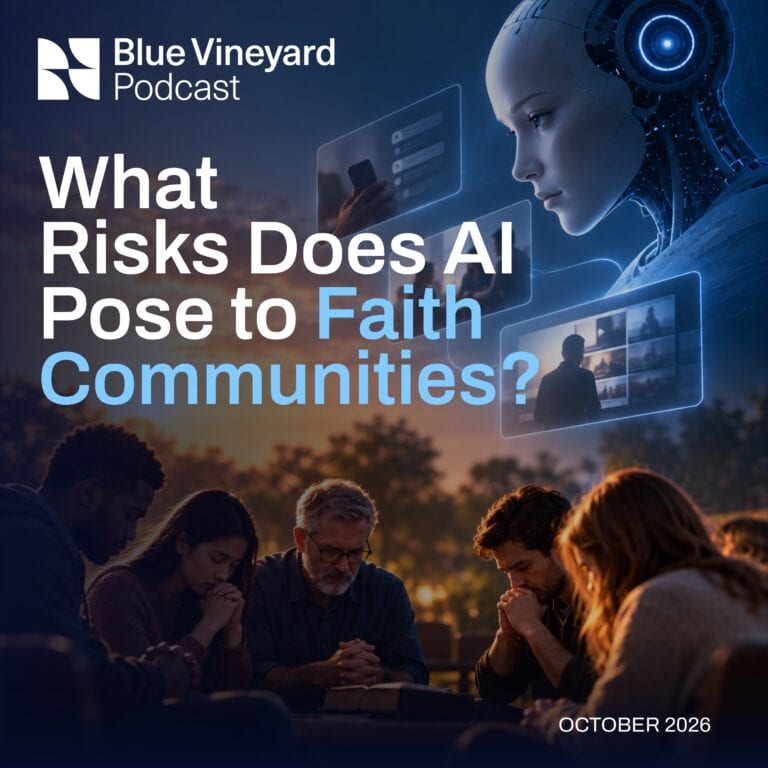
Everyone’s asking whether AI will end the world. The quieter risk is that we stop thinking for ourselves, and stop listening to the people God placed around us.
Luke and Adam’s hypotheses = the biggest danger is either painting AI with too broad a brush, or relying on it until we can no longer feed ourselves.
This episode features insights from Brent Hardinge, Pastor Wes Via, Craige Young, Pastor Puia Fanai and Pastor Russ Willcocks. They explore the risks AI poses to faith communities, from outsourcing our thinking and drifting from the local church to deepfakes, surveillance and a growing divide in our congregations.
This is Part Six of AI in the Age of Christianity, please subscribe to help us grow.
FEATURED VOICES
🔗 Brent Hardinge: https://www.linkedin.com/in/brenthardinge/
🔗 Pastor Wes Via: https://www.linkedin.com/in/wes-via
🔗 Craige Young: https://www.linkedin.com/in/ucyinc
🔗 Pastor Puia Fanai, Hope Channel: https://www.linkedin.com/in/puia-fanai-21945b196/ | https://www.facebook.com/rspuiafanai/
🔗 Pastor Russ Willcocks: https://www.linkedin.com/in/russ-willcocks-13126640/
CONNECT WITH BLUE VINEYARD
🔵 Subscribe for more insights on faith and technology
🎙️ Audio Podcast: https://rss.com/podcasts/bluevineyard/
🌐 Website: https://bluevineyard.com
💼 LinkedIn: https://www.linkedin.com/company/blue-vineyard/
✉️ Get in touch: [email protected]
Episode transcript 7,148 words
Hey everybody, welcome back to the Blue Vineyard podcast. My name is Luke Farooja and I am here with my co-host, Adam Weeks. Adam, how are you today? Luke, I'm doing great.
Thanks for asking. Yeah, the birds are singing, flowers are blooming. Life is good. How are you doing, my friend?
I'm doing great. Today we've had some... some technical challenges, and I am very happy that they have been resolved. And I'm keen for this conversation. I think this series has has been a real journey.
And so I'm pretty excited about today, actually. Luke, do you think that someday we'll be able to just like, hey, I fix all of my technology problems? Do you think that's going to happen? It would be nice so that it can just turn it off and turn it back on for you.
Yeah, that seems to be the way it works. Speaking of AI. Oh, man, Luke, we are coming near the end. We've got one more podcast after this, but I'm going to lean into what we're talking about today because this is a really important question.
I think it's honestly potentially one of the biggest questions that are on the mind of so many of you out there. It's what are the risks AI poses to faith communities? What do you think, Luke? Well, it's it is something that we've been we've been talking a lot about.
And obviously, we've got some input from, you know, experts in the field, and we're going to get to that. But I do think that this is one of those biggest points of fear that people express. And I'm interested in in where we go with that. But Just before we do jump in, I just wanted to say if anybody, number one, if you haven't listened to the rest of the series, please go back and listen to that because we've been building one layer at a time as we've been working our way through.
The other thing is that if you have been enjoying it, we would really appreciate a rating or a review on whatever platform that you listen to us on because that gives the indicator that this is worth listening to and other people should listen to it too. So if you've had any value from this series, we would really appreciate a review or a rating on your platform of choice. To get us started though, we like to start with our own hypothesis. Where do we begin with this?
And so, Adam, from your perspective, what is your hypothesis? What are the risks or the main risk that is approaching faith communities as a result of AI? To me, one of the things I'm seeing online is that there's a lot of fear. around AI and increasingly I'm hearing it was kind of like oh AI is cool and fun and now there's this pendulum to swinging like it's going to be the death and demise of us all whether it's environmental impact or you know taking away the creatives or all of our jobs or all of these things and so I think one of the things when we are talking about this I think it's important to paint the AI picture with a smaller brush I think some people are taking a really broad brush and saying bad AI. And in this case, in our context, can say it's bad for our communities, for our spiritual communities that it is, or it's just good.
It's going to fix everything. And that's where I think the biggest risk is, is painting with just a broad brush and saying all AI. As with so many things, AI is not one thing. There's a lot to it.
That's where it takes conversations like this and the conversations we've had to get into some of those more nuanced points about what AI is, what it isn't, what the risks are, what the risks really aren't, what it should do, shouldn't do, all those kind of things. But yeah, Luke, I'm going to turn that back on to you. What's your hypothesis? What do you think?
For me, there is one huge and overarching problem. that I see, and that is the way people are relying on AI. And just like when people feed wild birds, they become used to that and they can't feed themselves any longer, then the person goes away and all of a sudden the birds are all starving. I think this is, in my mind, one of the most significant, well-documented risks that is coming towards us. And we've talked a little bit about this on other episodes.
I grew up in a time where I so desperately wanted to understand the gospel and understand how to study scripture and to do it responsibly. I had the paper version of a concordance. That is how I cut my teeth on learning these things. I learnt the slow way.
Now I can use AI to do things quickly, but I have already built up a lot of experience doing things the slow way to have the critical thinking to be able to use it well. What I'm worried about is, you know, as a faith community, if our young people end up trusting AI more than their pastor, then like how anchored is their faith, right? So that for me, that was probably one of my core concerns. So I'm going to push back because that's what we do.
Yes. All right. So I was working on a fence. And would you agree that AI is a tool?
Absolutely. So I started working on this fence and I had a screwdriver. And I was screwing in those things. And someone said, Adam, what are you doing?
Why are you screwing in all of these screws into this fence? I've got this really cool tool. It's got a battery and it's just and because when you when you pick up a screwdriver that has a battery, that's the sound it's supposed to make. And so what I would say is like, you know what?
Yeah, you do half of them with the but actually you're really missing out. You really need to go back to just, you know, manually screwing in those by hand. Is that what you're saying, Luke? Yes, absolutely.
You need to go back to screw you. Drills don't exist, Adam, in this age. No, my argument, and like I think we will see a more nuanced perspective as we play some tape from our interviews. But for me, the fundamental difference is that whether I choose to do a fence only using a screwdriver or whether I choose to use a drill doesn't mean that my arms will atrophy and fall off.
But our brain is a different thing. If we outsource all thinking, just the same way, if I outsourced all dexterity and motion with my hands, I would lose that ability. would be absolutely true of The Fence as well. So we're not replacing it in a narrow vertical, we're replacing it in a broad vertical. And I think that fundamentally changes the game.
But what do I know? As with all things, there are nuances. And we've got a few people that we have interviewed. If you have been paying attention to this series, you know that we interviewed a number of people.
And I am excited to talk to our first interview. Yeah, Luke, who did we talk to? Yes. So the first interview that we have set up is with Brent Harding.
Now, Brent has been on the show a few times, so you probably have context for him. And I think he raises some really interesting issues and they're actually around my primary concern, which I've already expressed. So I'll let Brent speak for me and we'll come back and talk after. I think AI poses the risks of choosing not to think.
As a teenager or even middle schooler, if I had had the choice or the ability to use AI, I'm not the greatest writer and I'm sure it would be tempting to use AI to generate papers or even to use it as a starter for that. I think the risk that where that poses or where that solves for a faith community is similar. We give up our choice, not necessarily our ability, but definitely we give up our choice to think and to choose what we do and to process information. And so I think that's probably At least at this point, that's where I would see one of the bigger risks is how we process things from a SACE and Christian standpoint.
What do you think about his perspective there? Do you think that is a warranted concern or is it all sunshine and rainbows and unicorns? It is warranted and even to disagree with my earlier point is that there are certain times when in order to understand something foundational, you have to build the foundation. And that does take, like picture this, let's use our muscles, our bodies, but also like we have a muscle in our head.
If you were to go to the gym and you're like, I need to go work out. I haven't worked out for a while. And you get to the gym. And there's a big guy over there and he's just ripped and like, Hey, would you do me a favor?
Could you do like, like 20 curls for me? I'd really appreciate it. That'd be great. Like, what's the point?
Like, you know, you could ask someone to do something. So back to, you know, what Brent is saying is that we can't if we don't want to outsource our ability to think there are these foundational things as he's learning to to write, you kind of need to go through some of that struggle. in order to be a good writer. And yeah, it's kind of a scary time if you were just starting this, you know, if you if you only had AI to help you write and you never had to struggle through pen to paper. I think there's two aspects here, right?
There's, there's the responsible use of AI, because there's actually been some really interesting studies done recently around, like exam results for you know, people in places where AI was used. And in some places, in some cases, it was used as an assistant. And in some cases, it was used as a learning companion, right? And the ones that use it as a learning companion, the outcomes were dramatically better than the ones that just used it as an assistant to answer the questions or do the tasks.
I wonder if there is a piece of the puzzle that is in education and responsible use of AI, like how do we use it to make us better rather than, you know, use it to outsource our intelligence, just like you were just saying and Brent was saying. I think there's an other aspect to it where just harkening back to the screwdriver to build a fence illustration that you were using before, if we do end up with a situation, because I just thought of another place that this exists, right? Gyms. Gyms exist, but...
Did they ever exist, you know, when everybody was an agricultural worker, you know, on the farm? No, it didn't. But it's because we invented a abundant and sedentary lifestyle that was not good for our health. And then we realized at some point, hang on a second, we're all fat and dying early.
This is not a good thing. We need to do something about this. And so there was this culture of, oh, we need to proactively go and do things that we don't need to do in order to live to make our bodies healthier. And I wonder whether the mass adoption of AI will push in that direction, where people will be saying, yeah, I don't need the screwdriver to do the fence anymore.
And there's enough of those things that exist now, so I don't actually need to think very hard. Is there the equivalent of a gym but for the brain that will become a part of what we do to keep our cognition working well into our old age? I don't know. That's just a hypothesis.
All right, Luke. I've got a business idea. I think we're onto something. All right, just a chain of mental gems because they're all gonna atrophy with AI.
I think it'll be huge. Do you know what we could call it? We could call it a library. Sorry, I gotta get off this train.
That sounds vaguely familiar. I've forgotten though. Oh man, get out that card catalog and yeah, work that muscle. On this line of thinking, it's this idea of replacing our agency, I think, is another part of this.
And I was talking to Wes Vye, Pastor Wes Vye, and he was kind of sharing this idea of, will AI replace agency of thought and disconnect us from local church? I want to kind of transition into these, how does this reflect in the local church? Let's listen to Pastor Wes. What are the risks that you see that AI poses to faith communities such as ours?
Yeah. I mean, the biggest risk is people just outsourcing their agency of thought to AI. And honestly, this isn't a new risk. It has been an issue ever since mass media became a thing.
From the moment that a pastor could record a sermon, it gave people the opportunity to decide who they would listen to, who they would trust, and it began to kind of separate out what I think is really one of the most important parts of the local church. And this has been kind of lost, but before I was a pastor, at my home church, I was talking to the pastor that was there at the time. And for whatever reason, I guess, as he knew I was on a track towards the ministry or whatever, he opened up to me and he said the hardest thing that he had to deal with was that he was being judged by the people in the pews based on whether or not his sermon aligned with whatever the television preacher, their Adventist preference, whether his sermons were preaching the same thing, or as good as these preachers that people watch online or on 3BN or whatever. And he was breaking down.
What it made me realize at that moment was that there's something significant about the fact that God constructs the local body to be physically contained together. And there's something that I think is missed. By the majority of people when we get this mindset that I don't have to listen to the pastor that that God has put here Like I can just dismiss him because I've got this pastor over here that I prefer Yeah, and and I think there's something special God does both for the pastor and for the congregation and putting them together So that they can edify one another iron sharpening iron all those tropes, right? that that there's something special in what God is trying to communicate through that pastor for that church that you're not going to get from just listening to a sermon from someone else. And I think the same threat exists with AI that as we see more and more kind of like one-off AIs where people are building these AI tools to search the writings of Ellen White, right?
And so that you can talk to Ellen White or you can talk to this person or... There's a John Piper AI now, you know, like these AIs that are supposed to be trained on this one pastor that someone can decide that this person who I've never met, who doesn't know me, who wouldn't preach my wedding or my funeral, or even knows that I exist, I'm going to choose to listen to that person. And now they're going to have the opportunity to have access to the breadth of everything that person has ever said publicly or written. And they'll no longer be able to being honest be led by the spirit because they have decided well this person was led by the spirit and i trust them and everything i've heard from them is good so i'm just going to go listen to them so when they have a question they're not going to wrestle with it for themselves and these are all things that are already happening it's just the ai is going to escalate it right because this has her book this happens with sermons um you know and And so, and I think, you know, the difference between a sermon and a book is that a sermon is an anecdotal exploration of a topic, whereas a book is an exhaustive exploration of a topic.
And so, you know, a book, you read a book, you're getting a complete thought. A sermon, you're getting an anecdotal thought. You come to AI now and you're just getting sound bites. You're just getting whatever is the most reasonable answer.
That's, I think, the biggest threat is that people will just even more so just farm out. Their their agency and it will cause them to be disconnected from the local church even more than many people already are Will cause them to disconnect from their brothers and sisters even more than they already are it will cause them to stop Wrestling with and listening to the spirit because they'll just take it wholesale as an answer I really appreciate what pastor West said there especially the beginning when he was Essentially what he did for me is he put into words this emotion part of it that I've been feeling about one of the threats of AI to our local congregations. And how he positioned it is that like, all right, you can listen to the most amazing, and we've been able to do this on YouTube for a while now, where you can listen to the most incredible pastor speak, you know, and that pastor has had access to all these resources, and has had years and years of speech training and all that and delivers this incredible sermon. And you are, as the pastor there, judged against that.
And theologically, it's like, all right, the local pastor, from a pure performative perspective, can't compete. That other pastor, there's always somebody who's a better speaker. You just can't compete. But that pastor on YouTube, yeah, wasn't there at your wedding, wasn't there at the baptism, wasn't there for those life events.
And it's that relational thing. It's the human. It's what makes that pastor the person you connect with. And so if you're just judging that pastor on, OK, they're theological, how they're able to communicate an idea.
It's like, yeah, that other pastor is better at that. But this is the pastor that I'm doing life with, like I'm experiencing with. And that can't be replaced by YouTube or by AI. Yeah, I really liked that. the way he attached those ideas together of this has been happening with media for a long time.
Even for us, for my family, we weren't able to go to church for a little while. And while we weren't unable to go, we were on Sabbath, we were thinking, oh, well, we'll watch a service. I said to my wife, I said, oh, let's watch this one, whatever this one is that I wanted to watch. And she said, no, no, no, we'll watch the live stream from our local church.
And I was like, you know, I know who's preaching today, not the most inspiring communicator. I'd like to watch this. And her response to me was really challenging for me. And she's like, no, because we have a connection to our church. and like we know these people and like God put us here and like yeah we can watch those other things but right now in this moment like our church is like worshipping together and like it's more important that we have that connection and we worship along with our church seeing as we have the opportunity to right the stream is there and I didn't like that at first but I thought about that later and I was like you know that that I think she's right like even though I can and I can go watch those other sermons in my in whatever time slot I want but being away from our own church for a period of time was, oh, well, this is a way to stay connected.
And these are people that actually know us. And I believe the Holy Spirit is working through to connect with us. And I don't just think that works from the perspective of just the preacher, but I think all of the mentorship and the stuff that happens in a local church is like it is inspired and it is for our, you know, for a way for us to grow with God and in that community setting. And yeah, I can absolutely see how AI, being the first place that people go, would break that down.
So yeah, I can totally see his point. And I think there's an interesting counterintuitiveness to this because sometimes I've been going to places and I'll see a poster. I was like, oh, that's a really well-designed poster. I hate it.
It's AI. It's beautiful. It's perfectly done. I hate it.
Too perfect, yeah. I'll see. Yeah, I'll see a video and I see a person and they're back like the sound it's it's too perfect. Like they are there's no way that person is miked that well.
Like, oh, I hate it. Because it's AI. It's too perfect. And just like my gut and I don't I don't have an aversion to things because they're a you know, on a more I just like, no, I don't relate to it.
Like that's it's less valuable because of its perfection. And I want a humanistic experience. Obviously, there's a paradigm of this like, yeah, my local church is terrible. Like that's, you know, at some point, that's a different question, right?
That's a different question. Like, hey, I need to get more involved and help it be better or whatnot. But yeah, that super polished speaker, you know, that pastor on on YouTube, or that really well crafted, you know, thing that AI makes part of the thing that I don't like about it is it is not It is too perfect and it is not human and it's not mine. It's not my community.
Yeah. You know, one of the risks that was identified that we haven't even talked about yet was deepfakes. We've had some thoughts from Craig Young about this and I'd love to share those just now and then let's explore this as a different thread. And these are real risks that are out there.
We have seen them so many times. you and I can be cloned and, you know, be with Katrina seeing different things. So, there is, there is, how do we check when we see all these things online? Videos and posts that says, you know, this is happening and this person said this, you know, this is what is happening in this church. How do we make sure we check?
And it's not very easy. And the AI is is getting so sophisticated that, you know, it's hard to tell what is real and what is not real. So those are the risks that people might find that, you know, information in course, built course via social media, which is a clone of someone saying something against a church or a pastor saying something that I didn't see. I just take in one information and twist it to make it sounds different and then... put the church in dispute, ruin reputation.
Just last week I wrote a piece on my LinkedIn, which I was a follow-up from what I saw online about how in the education sector there's no policy in place about a child using fake information of a teacher. and spreading it, where then because of the policy that the education system will have, that teachers' repetition can quickly go downhill because of fake information a child puts out. And this is how we look at policies for that and similar situation in the church setting. Pastors' repetition can go down very easily based on an AI generated. video or something like that, that is out there and people take it because it's harder to disprove this information nowadays. So how do we cater for those things?
How do we make sure that we have the policies and things in place? So if these things happen, there's a system in place to deal with it. Understanding how to see what is fake and what is real. cultured check, you know, cross check, those are things that are not the different platforms are trying to make sure things are used to mitigate against these. But it's not easy.
And if you if you are not somebody who are interested in knowledge and AI, then it's hard for you to understand a fake pose. So before you had like phishing and you know up to like two weeks ago I was at a conference, an education conference and phishing was you know you would send an email and with a link and somebody tickling that no it's not that way social engineering that is being used so somebody will build a relationship with you over a period of time before they send you something so they gain your trust and then They then send a link, and because you have had news conversation on the phone and you have been having news conversation on emails, you start to trust the person and they send you something. That's how it is happening now. So it's getting harder to detect, but it's about the safeguards that you put in place and the education that you give.
His perspective triggered two thoughts for me. One was, I know even in my family, my parents will often send me a video like, oh, look at this. Can you believe that this is happening in our churches? And I look at it and then I'm noticing, yeah.
No, I can't believe it's happening in our churches. Why? Because the lady's handbag disappeared while she was talking. There are these things that...
You can see that it's happening and it's already happening when the software or the deepfakes are at this level. Can you imagine how much harder it will be when it's indistinguishable, right? And I saw a little microcosm of this happening back, it was probably around, I want to say 2014 thereabouts, the Pope, the Pope that we had at the time, somebody like had, from one of our churches, had got a video of the Pope delivering an announcement at the Vatican and had resubtitled it, right? Because the Pope was speaking in Latin or whatever and they had resubtitled it and it was like a disaster movie that would be written by the strongest conspiracy theorist of our church, right?
It was like the Pope admitting to all these things that had been done and it was so crazy, right? But because it was on a news broadcast and it was just subtitled over the top of a news broadcast, it all looked official. And there were so many comments of people like, oh, I always knew that this would be true and da da da da, like the whole thing. And it was even published in our church publications that this had happened.
Now this is, we have more capacity to do things that are even more deceptive than that now, but the thing that really bothered me at the time was this damages our reputation because it makes us look crazy, right? Because people accept these things as being true. And yeah, even just this week, uh, there was a, um, a, uh, you know, there was some influential people from our church, uh, who have been arrested for something. And this was displayed in social media.
I saw it. My first interaction with it was, Oh, AI. Yeah. Scrawled past it, right?
And then I found out after that it was true. And I'm like, well, this works both ways. You know, like this is damaging. So my question for you, Adam, is what sort of safeguards make sense for this?
Yeah. I think that oversight is needed, not blanket oversight, yet nuanced oversight with specific, with people who know what they're talking about with good intentions for the public to an oversight. on top of oversight where there is layers of it and people can get called out. And so it's not just one person with the big no red AI button. There are multiple ways that that can happen.
And again, in similar ways that we have regulations around airplane flight or cars driving and safety things like those things, those. when you when you drive a car there's a big book of all things you need to read and there's a huge even much bigger book around people who build the cars and all the safety things they need to do and I as much as that is it's scary and that it you know it it slows things down sometimes slowing things down makes it in the end makes it safer for everybody And I think that's where we need to go. It's scary on who gets to decide, but I think that's the direction it needs to go. All right, so we've been talking about how AI can be used to replace our agency, destroy reputation. That's some scary stuff.
Could it destroy our very existence? It sounds almost silly to even to go there. Like, no, it's my computer. Like, what's the big deal?
But this is actually what some people are discussing, and it's making the headlines. You know, in 10 years, you know, there's a 10% chance that it'll wipe out humanity. I don't know how you get those stats, but this is a conversation that is being had. And we're going to pull up Pastor Puja.
He had some thoughts on this and end time events. Let's go ahead and take a listen. Oh, I think there are a few layers there, I think. As Revelation 13 clearly tells us, there will come a day when the entire world will come under one system that will enforce the mark of the beast.
Even though we don't know exactly the details of that setting in their future, but I think it's very clear that AI will impact our faith communities to the point of us being on the suffering end of the tools of AI, right? Imagine, like, one day, you know, that finally, the point finally comes to, hey, are you going to follow the systems of the world? Are you going to keep the commandments of God and stick to the Bible? If you do, we're going to find you.
We're going to find where you live. Oh, with AI, it's going to be very easy to trace all of my information or even turn off my bank account with a few clicks. that I'm done with my being able to participate in the world economy. So I think that's another layer of AI impacting our faith communities. Luke, the sky is falling.
The sky is falling. Is the sky falling? Is this a harbinger of things to come, of prophecy, or is this just the next thing? I believe there is multiple ways for things to be correct.
I think, does this make it easier for large organizations and governments to identify individuals and change how they interact with the economy and society? Yes. Is it going to be the mechanism by which all things end? I don't think we have enough data to suggest that it does.
Is it a tool in, in that machine? Probably. But before AI existed, like let's, if we hit rewind, let's go back to 2018, you know, and we're in a pre AI era. Could the government find basically any individual at will based on their mobile phones, you know, their transaction history that, yeah, very quickly.
Right. So I don't think that we are seeing a fundamental shift. Do they have more information on us? Yes.
That is all true. And I think the substantive difference is that if you're using AI a lot, and you're using it for a lot of personal information and the information of your friends, it will make networks much easier to track. So it's like, this person is connected to that person. And so if we were in a hunted scenario, yeah, OK, all of those things are true.
But I don't think it really changes the end game at all. So therefore I'm less worried about it. One extra thing I feel the need to insert here, and this is maybe just me getting a little bit techy and into my lane over here, but I think this risk will diminish. It is high right now because all of the data lives in the cloud.
I think that AI will progressively become more and more an on-device experience. And the more it does that, the more control you'll have over your data. And so I actually think that the level of information harvesting that's going on right now will decrease, not increase. Anyway, that's my own hot take.
The devil doesn't need AI to do the devil's work. I think that the devil is capable without. And yes, things can be done faster and quicker. But a lot of the things that we worry about, we already gave up when we when we got a phone, I was when when smart speakers were becoming a thing, I was talking I was a principal at the time and about having a smart speaker in the classroom.
And the idea was, you could tell to play music or you know what not make the kids and answer questions. And this guy who actually was in technology like, Oh, you know, I just don't like the idea of having a microphone in the and with all the students like I don't know if that's you know safe I was like what's what's sitting on the table right there like my phone like what does it have it's got a microphone and a camera and an internet connection device you know it has all the things you're worried about this like it's just it's in a different package and the moment that you felt safe having a cell phone You gave away a lot of those other, like, logical things to fear those other things. So yeah, can things happen faster? Yes.
Could this be a harbinger of things to come? But I don't know that in and of itself it is that sign because we've had bad people doing a lot of bad things for a very long time. So we'll see, I guess. Yeah.
Yeah, I guess so. From the conversations that we had, there's one more clip that I want to play. And from a conversation I had with Pastor Russ Wilcox, I appreciated so much of his perspective throughout the interview that I had with him. And in this particular piece, he's talking about its propensity to divide a community.
And I think this is something that fits very neatly. It dovetails well. with what Pastor Wes was sharing earlier. And yeah, I'd just like us to have this as our last clip today. Yeah, I think for a faith community, it's not so much a technical, it's not only a technical challenge.
I think the risk that AI presents to faith communities, if we don't govern this well, if we don't approach it well, we could become overly dependent on technology and news. that emphasis on prayer, on the scripture, on relationship, on that incarnational side of history. I think, I think we could take two fat nations that are adopting a really wise approach to this. I think in the past was false. The leaders of faith communities, I think one of the dangers, one of the risks is really that pastoral leaders could lean into just generating content. which appears to be missing that spirit, the Holy Spirit element.
We need that. We need the Holy Spirit speaking to the people. We need leaders who are listening to that and sharing that out of a surrendered heart. I think, Tim, there's a risk, at least in the next few years, that some of our people might...
You know a local and it is out there for a lot of people and it's too hard. It's too new It's too scary. So we could end up the habs and have nots or the the people who understand and use these tools versus The community that's maybe left behind and so we could see at the time I you know, you know communities And I think yeah Just trying to move together in a way that takes the pain community on this journey in a beneficial way. I think that's the challenge.
Some of those concerns are very relevant to different parts of the community. In your experience, Adam, because I know you've worn a lot of hats, being a teacher, youth pastor, you shared a bit of the story of having a smart speaker, but in your experience, do you think about this? think about the use of AI when you're utilizing it and ask yourself questions around, like, does this divide? Does this unify? Like, what is being used here?
Or do you just see it purely as the tool and it really just doesn't cross your mind? I think with any tool, somebody who thinks of their craft in a way that they are a professional or they do something with intention, picks up the correct paintbrush. at the right time picks up the you know, the correct tool. And it's knowing when to use it. And I have had things experiences with AI where I never would have gotten it done.
It couldn't have existed. It did it in a way that helped me help somebody else that I couldn't have helped them without it or I wouldn't have. I would have taken much longer. I wouldn't have you know, there's there's things about it.
There's there's nuance to it. And so I think even back to, and I know we've been talking analogies or metaphors. I forget the difference. But when it comes to like painting, people painted for a very, very long time.
And then the photograph came out. Did it make the painting less valuable? Like people, it changed kind of how people would think of paintings to some degree. You may have gotten fewer painted portraits, but painting is still important because it's It's part of who that person is.
And maybe someone would have taken a photo of something and then painted what they saw the photo of. There's ways that we're going to use AI that we haven't thought of yet. But as we use it, I don't think it should be the gut reaction to just use it no matter what. I think it needs to be something where Is this the right tool for the job to help the people that I want to help?
And is it actually going to be a net positive? Yeah, no, that's very true. And I, I appreciate that perspective of knowing the right tool at the right time. And I think that's a part of, well, we did it as a society before, right?
I think social media is a great example of this. Like in that, in that first wave, parents were like, Oh, you're on like, you're on MSN. Great. So cool.
Like it's a new thing, you know? And then eventually we got to the place of like, oh, hang on a second. This is actually important that we decide how to use this thing, right? And I think we're crossing that curve much quicker with AI, but we're doing it in a similar way.
Early adopters, there's no limitations. Everything's great. And then we realize the risks and then we try to mitigate those risks. And, oh, this is a tool.
It's used for certain processes and this is the safe way to achieve it. So yeah, no, I do like that. I appreciate that. Yeah.
Do you have any final thoughts before we wrap this one up? So yeah, as we close out our, you know, our thoughts around AI and how the risks, what the risks are to our communities, my request is that we paint with a nuanced brush, not a broad stroke. And regardless of anything is that we put people first. We put the work first and what we can do with AI may be great.
It may not be. Pay attention to what you're doing. Be curious. Be respectful of people and put people first.
Having that said, I'm curious what you, our audience, what do you think? I would love to have you share with us. Drop a comment wherever you're listening to this. And what do you think?
Should we use AI? Is it a risk to our communities? Yeah, we would love to hear from you. All right.
Well, thank you so much for joining us. We're almost finished this series. And so please keep an eye out for the next episode to come out. That will be the last one in this series that we've been working on.
We've been really blessed to go through it together. If you have not listened to the previous ones, as I mentioned at the start, they're all there for you to enjoy. We do ask that if you have found value that you can send this to a friend to get their perspective on it as well. We'd love to increase the size of our community as we're wrestling with these topics.
But with that, we'll leave it there and we look forward to seeing you guys for the next episode.
Transcript is automatically generated and may contain errors.